The History of PUBG: How PlayerUnknown’s Battlegrounds Shaped a Genre
From Brendan Greene's Arma mods to Steam records, console launches and the 2022 free-to-play switch: how PUBG turned battle royale into a global genre.
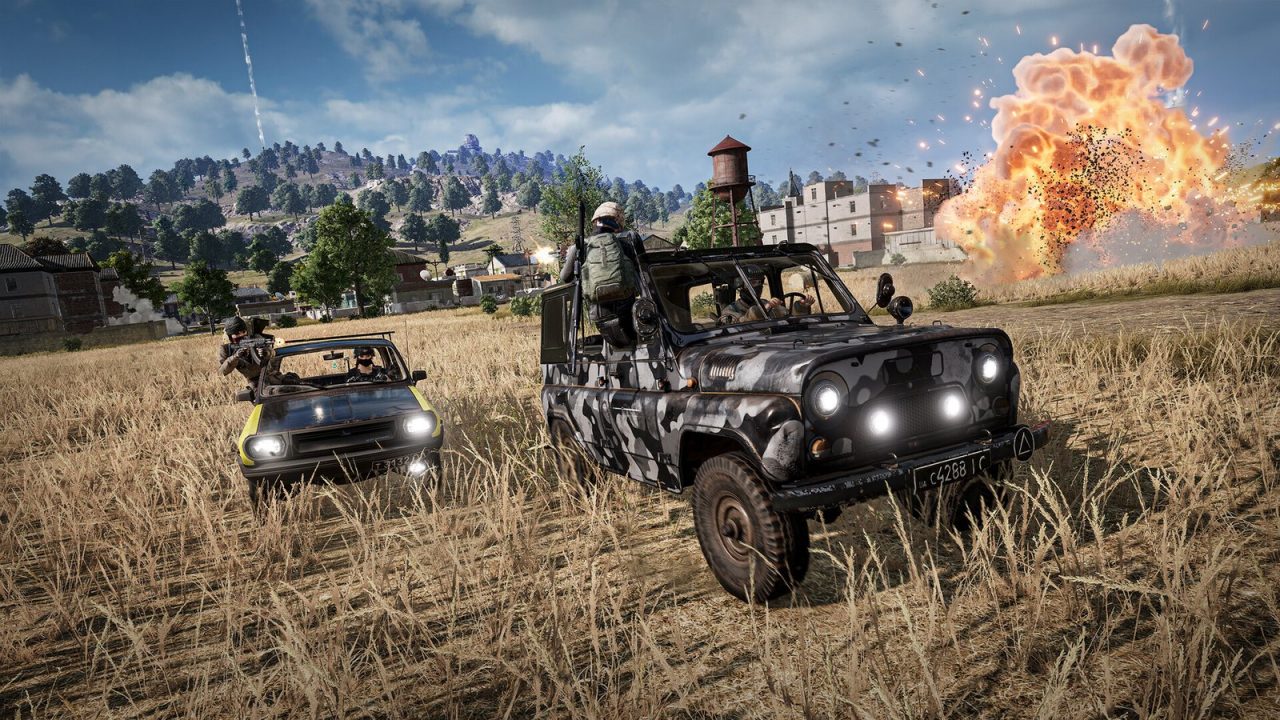
Few games have changed the industry as quickly as PlayerUnknown’s Battlegrounds. Within months of appearing in Steam early access in 2017, it was breaking concurrent player records, and within a year almost every major publisher was building a battle royale of its own. Today the game is called simply PUBG: Battlegrounds and is free to play, but its basic formula, a plane, a parachute, an island full of loot and a shrinking zone, is still the template for the genre.
This is the story of how a modder’s side project became one of the best-selling games ever made. For the wider genre story, including the novel and film that gave it its name, see our history of battle royale games.
PlayerUnknown: The Modder Behind the Idea
The “PlayerUnknown” in the title is Brendan Greene, born in March 1976 in Ballyshannon, Ireland. He did not come from the games industry. According to his Wikipedia biography, in 2013 he was living in Brazil, working as an event photographer and freelance website designer, while spending his free time modding games under the online name “PlayerUnknown”.
His first major project was DayZ: Battle Royale, a mod built on top of the DayZ mod for Arma 2, released in 2013 and inspired by the 2000 Japanese film Battle Royale. It took DayZ’s tense, realistic survival setting and turned it into a last-player-standing competition. When DayZ became a standalone game, Greene moved to Arma 3 and created PlayerUnknown’s Battle Royale, which introduced ideas that would become PUBG staples, including dropping players into the map from an airplane, and an online leaderboard.
Greene’s ideas then went commercial. In 2015, Sony Online Entertainment recruited him as an advisor for the battle royale mode of H1Z1, licensing his concept. That consultation ended around February 2016, and H1Z1’s battle royale mode, later known as King of the Kill, showed there was a real audience for the format.
Bluehole and the Birth of Battlegrounds
The success of H1Z1’s battle royale caught the attention of South Korean developer Bluehole, which had acquired the studio Ginno Games in January 2015. Bluehole invited Greene to lead a standalone game built entirely around his concept, and in 2016 he joined as creative director and moved to South Korea.
The game was built in Unreal Engine 4 by a team that, by industry standards, was moving very fast. The design took Greene’s mod ideas and put them into a modern package:
- a large lobby of players dropping by parachute from a plane flying across the map;
- scavenging for weapons, attachments, armor and healing items;
- a shrinking play area, the Blue Zone, that forces players together;
- realistic gunplay with bullet drop and recoil;
- solo, duo and squad modes.
The first map was Erangel, a fictional Eastern European island with military bases, towns and open fields. It would later be named Best Multiplayer Map in Game Informer’s 2017 Shooter of the Year Awards.
2017: The Record-Breaking Year
PlayerUnknown’s Battlegrounds entered Steam early access on Windows on March 23, 2017. What happened next was extraordinary, and the dated figures reported on Wikipedia trace it clearly:
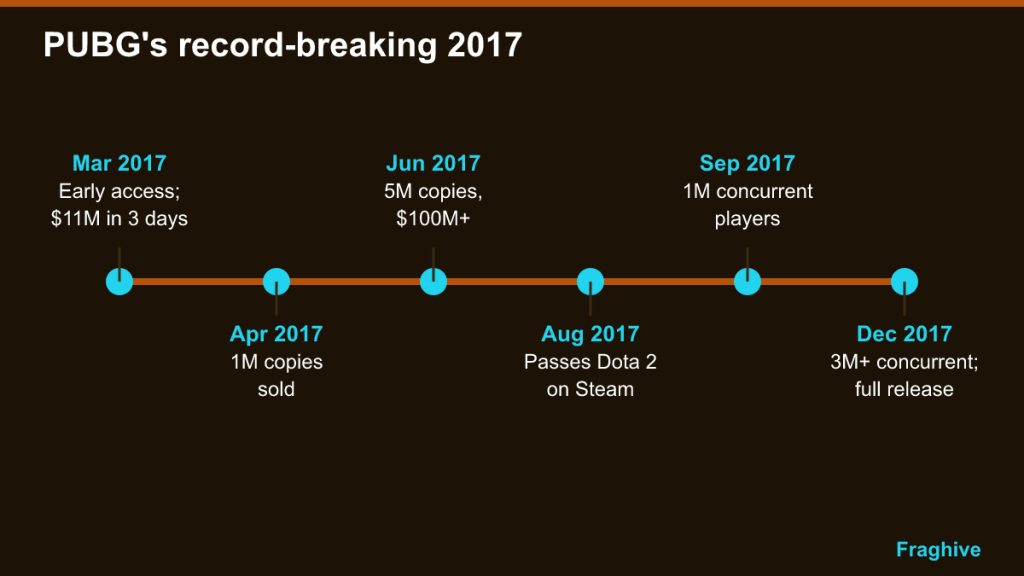
| When | Milestone |
|---|---|
| March 2017 | About $11 million in revenue in the first three days of early access |
| Mid-April 2017 | More than 1 million copies sold |
| May 2017 | More than 2 million copies and about $60 million in gross revenue |
| Around June 2017 | More than 5 million copies and over $100 million in revenue within three months of early access |
| August 2017 | Passed Dota 2 as the most-played game on Steam by concurrent players |
| September 2017 | More than 1 million concurrent players reported on September 8 |
| October 2017 | 2 million concurrent players reached |
| December 29, 2017 | More than 3 million concurrent players reported |
Overtaking Dota 2, Valve’s own long-time leader on Steam, was symbolic. At that point PUBG was not even officially finished. In September 2017, Bluehole moved development into a dedicated subsidiary, later renamed PUBG Corporation, with Chang-han Kim as CEO.
Competitive play started immediately too. In August 2017, the first invitational tournament was held at Gamescom with ESL and a $350,000 prize pool, an unusually large event for a game still in early access.
The game left early access with its full PC release on December 20, 2017. By that month, PUBG reported more than 30 million players across Windows and Xbox. At The Game Awards 2017, it won Best Multiplayer Game and was nominated for Game of the Year. Other honors followed: Best Multiplayer Game and PC Game of the Year at the 35th Golden Joystick Awards, Action Game of the Year at the 21st D.I.C.E. Awards, and Game of the Year at the 2018 Steam Awards, voted on by Steam users. Not bad for a game whose core idea had started as a free mod a few years earlier.
Consoles and Growing Pains
PUBG came to consoles in stages. The Xbox One version launched through the Xbox Game Preview program on December 12, 2017, before the PC version had even left early access, and received its full release on September 4, 2018. The PlayStation 4 version arrived on December 7, 2018. Sales kept climbing: 40 million copies across all platforms by March 2018, over 50 million by June 2018, more than 60 million PC and console copies by December 2019 and over 70 million by July 2020.
The rapid rise brought serious problems. Cheating was a constant fight: reports said the game’s anti-cheat systems were banning thousands of players per day in late 2017, more than 1.5 million cheaters had been banned by December 2017, and over 13 million by October 2018. Optimization and server issues were common complaints during the early access period.
The map pool grew beyond Erangel with the desert map Miramar, the smaller jungle map Sanhok and the snow map Vikendi, among others. Each changed the pace of play: Sanhok’s small size made matches faster, while Miramar’s open terrain favored long-range fights and vehicles. As of October 2026, the official PUBG site lists nine maps: Erangel, Miramar, Sanhok, Karakin, Paramo, Taego, Deston, Vikendi and Rondo. Erangel, still the game’s signature map, is listed at 8×8 kilometers, with famous locations such as Pochinki, Georgopol and the Military Base that have been fought over since 2017. The decision to keep adding maps of very different sizes, rather than replacing the original, gave PUBG a variety that many of its imitators struggled to match. Our PUBG maps guide covers the current map pool in detail.
Corporate Changes: Krafton and PUBG Studios
As PUBG became Bluehole’s defining product, the company restructured around it. In 2018, Bluehole created Krafton as a holding company, which took over publishing. In December 2020, Krafton merged PUBG Corporation into its studio structure as PUBG Studios.
Brendan Greene’s role also changed. In March 2019 he stepped down as lead designer of PUBG and moved to Amsterdam to lead a new group, PUBG Special Projects. In December 2019 he announced a project called Prologue under a new studio, PlayerUnknown Productions, and in August 2021 he left Krafton while keeping that studio. His later work focuses on technology for very large worlds; the studio released an “immersive tech demo” called Preface on Steam on December 5, 2024.
Fortnite and the Battle Royale Boom
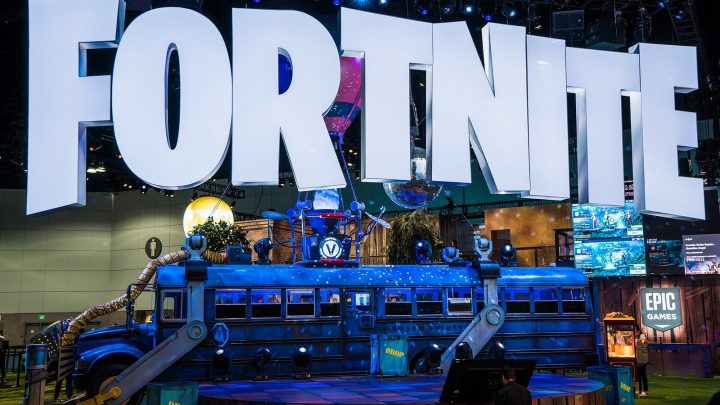
PUBG’s success inspired a wave of competitors. The most important was Epic Games’ Fortnite, which launched a free-to-play Battle Royale mode in September 2017, built on the existing Fortnite: Save the World with its building mechanics. Bluehole publicly raised concerns, and in January 2018 PUBG Corporation sued Epic Games Korea, alleging copyright infringement. The case was closed in June 2018 for undisclosed reasons.
Fortnite’s free-to-play model and building mechanic, Apex Legends in 2019 and Call of Duty: Warzone in 2020 all drew on the template PUBG had popularized. The genre’s rise was widely named one of the biggest video game industry stories of 2017, and PUBG was the game at the center of it.
A Mobile Detour
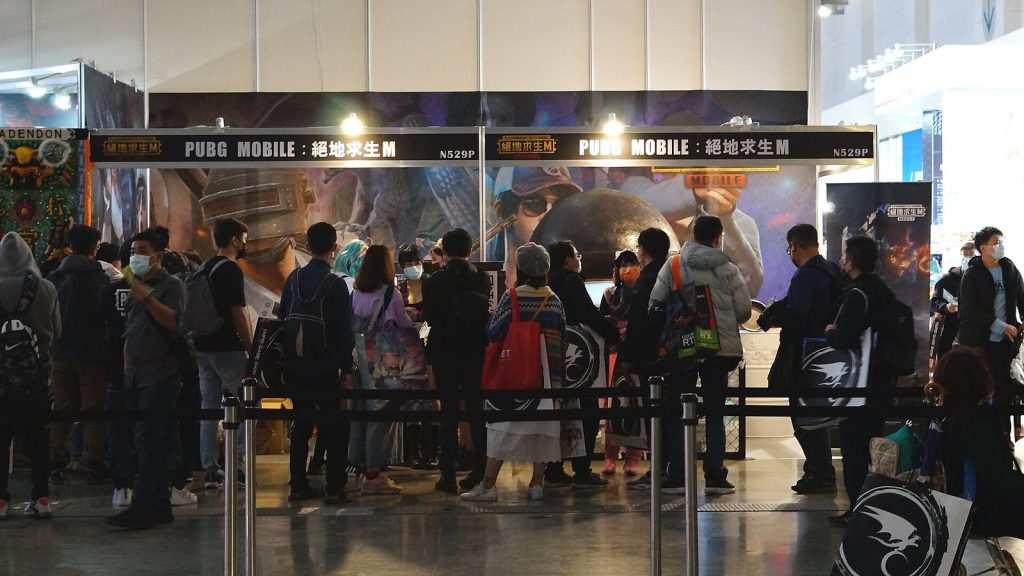
PUBG also became a massive mobile game. Mobile versions developed with Tencent entered early access in China in February 2018, and PUBG Mobile grew into its own global phenomenon. It is a separate product with its own update cycle, and according to Wikipedia’s figures, of the roughly $13 billion the franchise had made through the third quarter of 2022, about $9 billion came from mobile and about $4 billion from PC and console. This article focuses on the PC and console game.
Free-to-Play and PUBG: Battlegrounds
By 2021 the game faced a crowded market of free-to-play rivals. Around July 2021 it was rebranded as PUBG: Battlegrounds, dropping the “PlayerUnknown’s” from the title. On December 10, 2021, the developer announced the switch to free-to-play, and the base game became free on January 12, 2022.
The console versions moved to new hardware as well. On November 13, 2025, support for the Xbox One and PlayStation 4 versions ended, with native Xbox Series X|S and PlayStation 5 versions released. Through all of this, the core formula has stayed close to what Greene designed in his mods: a plane, a parachute, loot and a closing zone.
If you want to try the game today, our PUBG: Battlegrounds beginner’s guide explains landing, looting and surviving the Blue Zone.
Why PUBG Mattered
- It proved the format. Battle royale mods had existed for years, but PUBG showed the idea could support a standalone, commercial game with millions of players.
- It set the vocabulary. The plane drop, ground loot, the shrinking zone and the slow, tense final circles became shorthand for the genre, and later games defined themselves by how they differed from PUBG.
- It showed early access could work at huge scale. PUBG sold millions of copies before reaching version 1.0.
- It came from a modder. Greene’s path from an Arma mod to a global hit is one of gaming’s clearest examples of mod culture shaping the mainstream.