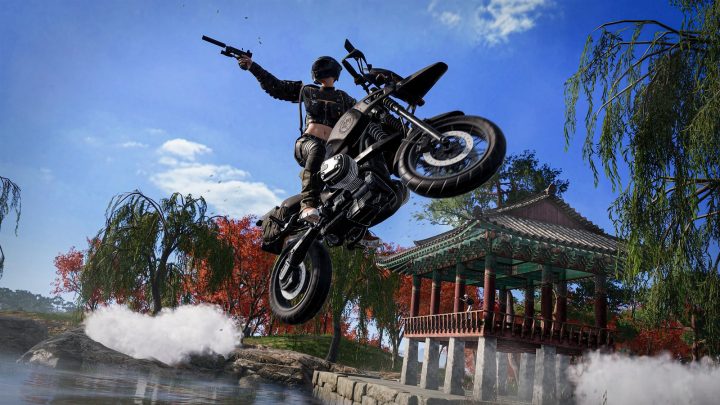
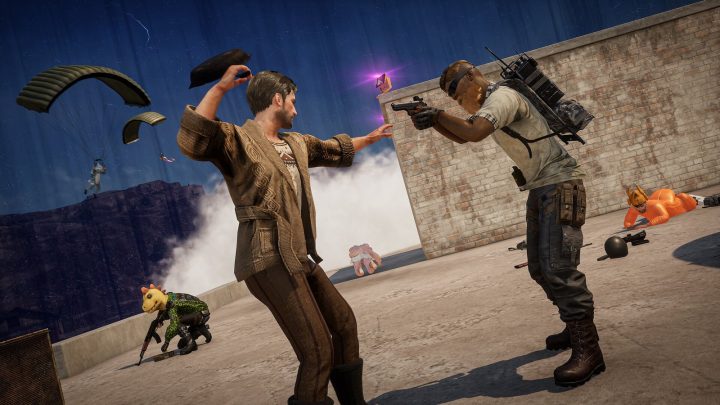
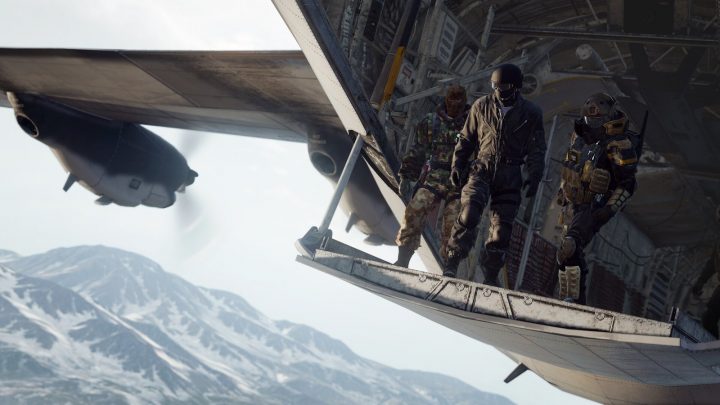
PUBG Maps Guide: Erangel, Miramar, Sanhok and the Rest
Every current PUBG: Battlegrounds map explained: size, terrain, pace and the locations and features that make each one play differently.
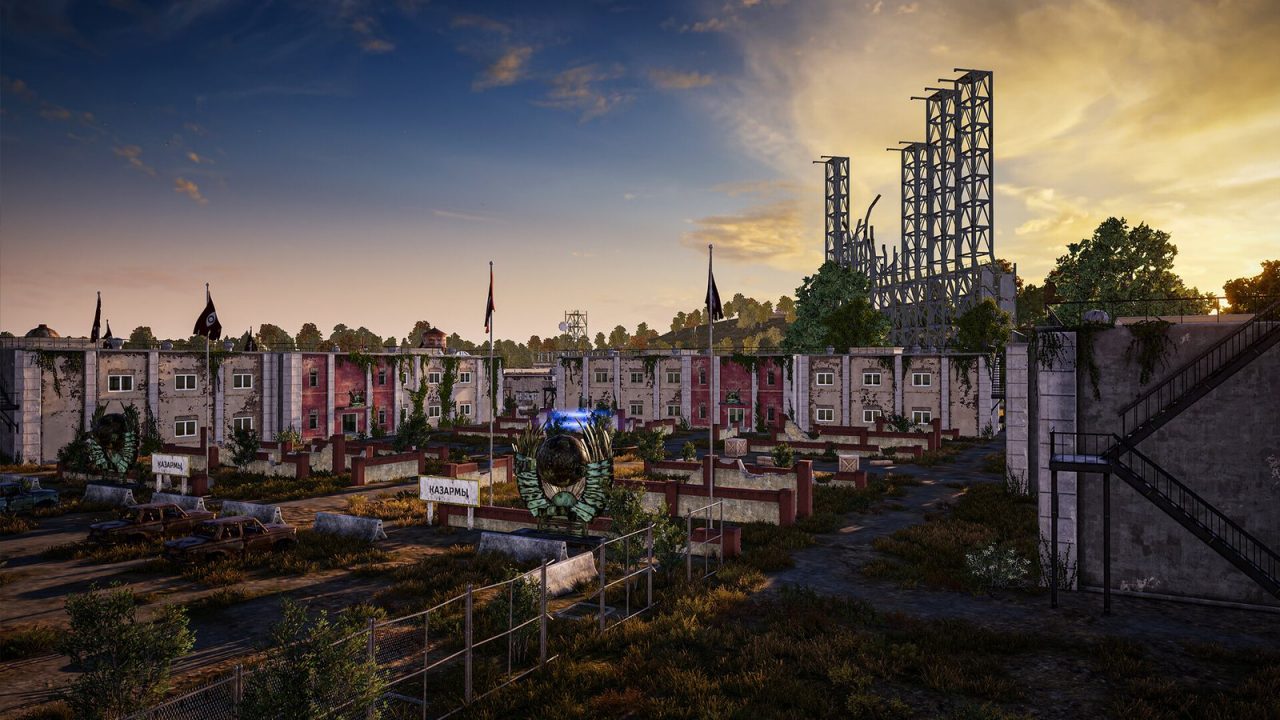
In PUBG: Battlegrounds, the map you land on changes everything. The same squad might spend a whole match sniping across desert hills on Miramar, then fight room to room in the jungle of Sanhok in the next game. Wikipedia notes that the game’s maps range from about 1 to 64 square kilometers, which is a sixty-fold difference in space per player. Knowing each map’s character helps you choose where to land, which weapons to prioritize and how to rotate.
This guide covers the maps listed on PUBG’s official map page as of October 2026: Erangel, Miramar, Sanhok, Vikendi, Karakin, Paramo, Taego, Deston and Rondo. Map rotation and selection rules change between updates and differ between modes and regions, so check the in-game map selection before you queue. If you are new to the game itself, our PUBG beginner’s guide covers the basics.
The Big Three Classic Maps
Erangel
Size: 8 x 8 km. Terrain: grasslands, forests, towering mountains, towns and cities.
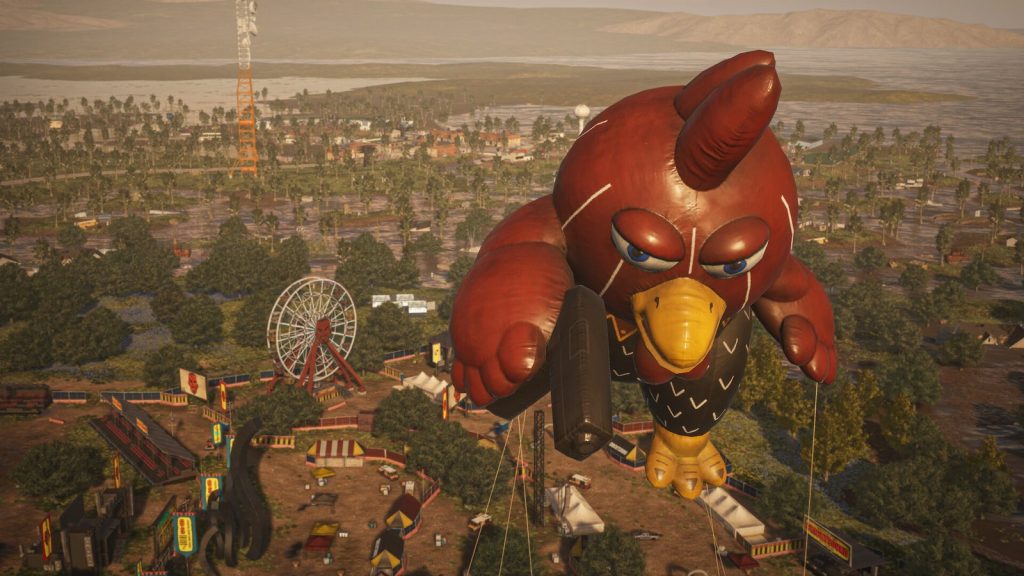
Erangel is where PUBG began: it was the original map at the game’s early access launch in March 2017 and has since been remastered. PUBG’s official site describes it as the birthplace of the fictional “godfather of the Battlegrounds” and lists notable locations including Pochinki, Georgopol, Stalber and the Military Base, plus features such as the ferry and secret rooms.
How it plays: balanced. Erangel mixes open fields for long-range fights with dense towns for close combat. The island is separated from the Military Base by bridges, which become famous choke points when the zone pulls across the water. Pochinki, in the center, is a classic hot drop. If you want to learn PUBG fundamentals, Erangel is the best teacher, because it rewards every skill: positioning, vehicles, long-range shooting and building clears.
Miramar
Size: similar to Erangel, one of the largest maps. Terrain: barren desert, hills, rugged mountains and towns.
Miramar, the second map added to PUBG, is a desert, and the official description calls it a haven for snipers because of its open terrain. Locations include Pecado, the Resort, Truck Stop and the Southern Island, and the official page lists sandstorms and ziplines among its features.
How it plays: long-range and vehicle-heavy. With little natural cover, crossing open ground is dangerous, so vehicles are vital for rotations and scoped rifles shine. Ridge lines and hilltop buildings are powerful positions. Miramar suits patient players who enjoy marksman rifles and careful planning.
Sanhok
Size: small (commonly cited as 4 x 4 km, a quarter of Erangel). Terrain: lush tropical jungle, rivers and ruins.
Sanhok was the third map and the first small one. PUBG’s official page describes it as a place where enemies are always nearby, making battles faster-paced. Notable locations include Paradise, Bootcamp, Ruins and Cave. Sanhok has also been remastered since its release.
How it plays: fast and close. Dense foliage and many buildings create constant short-range fights. Shotguns and SMGs are far more useful here than on the large maps, and the zone tends to bring teams together early. If you want quick, action-packed matches, Sanhok is the map for you.
Vikendi: Snow and Stealth
Size: medium-to-large. Terrain: snowy fields, mountains and forests.
Vikendi is PUBG’s snow map. The official site describes it as a wintry battleground with blizzards, and lists notable areas including the Observatory, Glacier and Lab Camp, Train Station, Lumber Yard and a Cave, with features such as snowmobiles, secret rooms, a train and a night mode.
How it plays: varied. Forests and mountains offer plenty of cover for stealth play, but snow leaves footprints that can reveal your movement. Medium-range rifles work well, and the map rewards players who use terrain carefully. Vikendi has gone in and out of the standard rotation over the years and returned in a reworked form, so availability depends on the current season.
Smaller Maps: Karakin and Paramo
Karakin
Size: small. Terrain: desert island.
Karakin is a compact desert island with a reduced player count (GGRecon reports up to 64 players). The official page lists Al Habar, the underground tunnels, Bashara and a cargo ship among its locations, and highlights sticky bombs, hidden spaces and the Black Zone, a bombardment that destroys buildings and terrain where it lands.
How it plays: intense and destructive. Open ground and breakable walls mean cover is never fully safe. Sticky bombs can blow holes in walls to create new entry points, and the Black Zone forces players out of buildings.
Paramo
Size: small. Terrain: volcanic highlands with an active volcano.
Paramo is PUBG’s most dynamic map. According to the official site, its layout changes with each match, making it hard to navigate even for experienced players, and lava flows and volcanic ash create hazards. The official page also lists helicopters and secret rooms among its features.
How it plays: unpredictable. Because the layout changes, there are fewer memorized routes and landing spots. Players must read the map each match and stay away from lava. Fights are typically close-to-medium range.
Newer Large Maps: Taego, Deston and Rondo
Taego
Size: 8 x 8 km (per GGRecon). Terrain: reed fields, villages and cities inspired by 1990s Korea.
Taego centers on Ho San Prison, and the official page lists locations including the Terminal, Buk San Sa and the School. Its notable features include multi care packages and a self-AED for self-revives. GGRecon notes that Taego also introduced a comeback system that gave early-eliminated players a chance to return.
How it plays: a mix of long-range open fields and tight villages. The comeback mechanics make early deaths less final than on classic maps.
Deston
Size: 8 x 8 km. Terrain: a hurricane-damaged city surrounded by swamps and flooded areas.
Deston arrived in late 2022. The official page describes a post-disaster urban swamp with desalination plants, algae farms and flooded sprawl, and lists locations including Ripton, the Arena, the Concert, Assembly and a hydroelectric dam. It introduced the Ascender, a device for climbing tall buildings quickly, along with a utility parachute and the airboat.
How it plays: vertical. Skyscrapers in Ripton create rooftop fights and long sightlines, while the swamps make vehicle routes tricky. Learning the Ascender locations is essential.
Rondo
Size: 8 x 8 km. Terrain: bamboo groves, a lake, ridges and modern cityscapes.
Rondo blends traditional and modern design, according to the official site, with lush bamboo groves and a calm lake in the southwest and varied ridges in the northeast. Locations include Jadena City, the Stadium, NEOX Factory, the Test Track, Yu Lin, Rin Jiang and Mey Ran. The official page also lists the Market, EMP and the JS9 SMG among its features.
How it plays: large and varied, with dense urban fights in Jadena City and open countryside elsewhere. Vehicles matter, as on all the 8 x 8 maps.
Maps at a Glance
| Map | Size | Theme | Pace | Best weapons |
|---|---|---|---|---|
| Erangel | 8 x 8 km | Fields, forests, towns | Balanced | All-rounders, ARs and DMRs |
| Miramar | Large | Desert | Slow, long-range | DMRs and snipers |
| Sanhok | Small | Jungle | Fast | SMGs, shotguns, ARs |
| Vikendi | Medium-large | Snow | Medium | ARs, DMRs |
| Karakin | Small | Desert island | Fast | ARs, sticky bombs |
| Paramo | Small | Volcanic | Fast, unpredictable | ARs, SMGs |
| Taego | 8 x 8 km | 1990s Korea | Medium | Mixed |
| Deston | 8 x 8 km | Flooded city | Medium, vertical | ARs, DMRs |
| Rondo | 8 x 8 km | Bamboo, lake, city | Medium | Mixed |
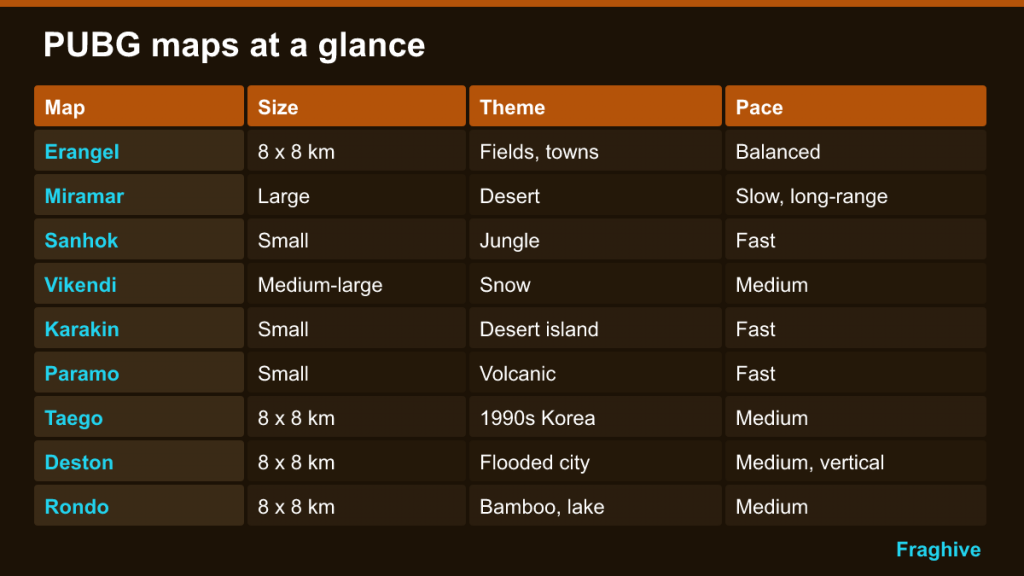
Sizes from PUBG’s official map pages where listed (Erangel, Deston, Rondo) and GGRecon (Taego); others described relatively.
Retired and Special Maps
PUBG has also had maps that are no longer part of the official map lineup. The best known is Haven, a tiny industrial island for 32 players that introduced PvE enemies guarding high-tier loot, according to GGRecon. The official map page does not list it as of October 2026. Remastered versions of Erangel and Sanhok have replaced their original layouts, and classic versions occasionally return for events.
Choosing and Learning Maps
- Start with Erangel to learn the fundamentals on a balanced map.
- Play Sanhok or Karakin to practice close-range fighting and quick decision-making.
- Use Miramar to practice long-range shooting and vehicle rotations.
- Learn one or two hot drops per map plus one quiet landing spot, so you have a plan for any flight path.
- Study the features unique to each map: Black Zone on Karakin, Ascenders on Deston, lava on Paramo. Unfamiliar mechanics are where new players die.
Whatever the map, the blue zone rules still apply, and our zone rotation guide explains how to move through it safely.