Valheim Biomes in Order: A Progression Guide from Meadows to Ashlands
Every Valheim biome in its intended order, with the resources, dangers, gear tier and boss that unlock the next step, up to the Deep North added in 1.0.
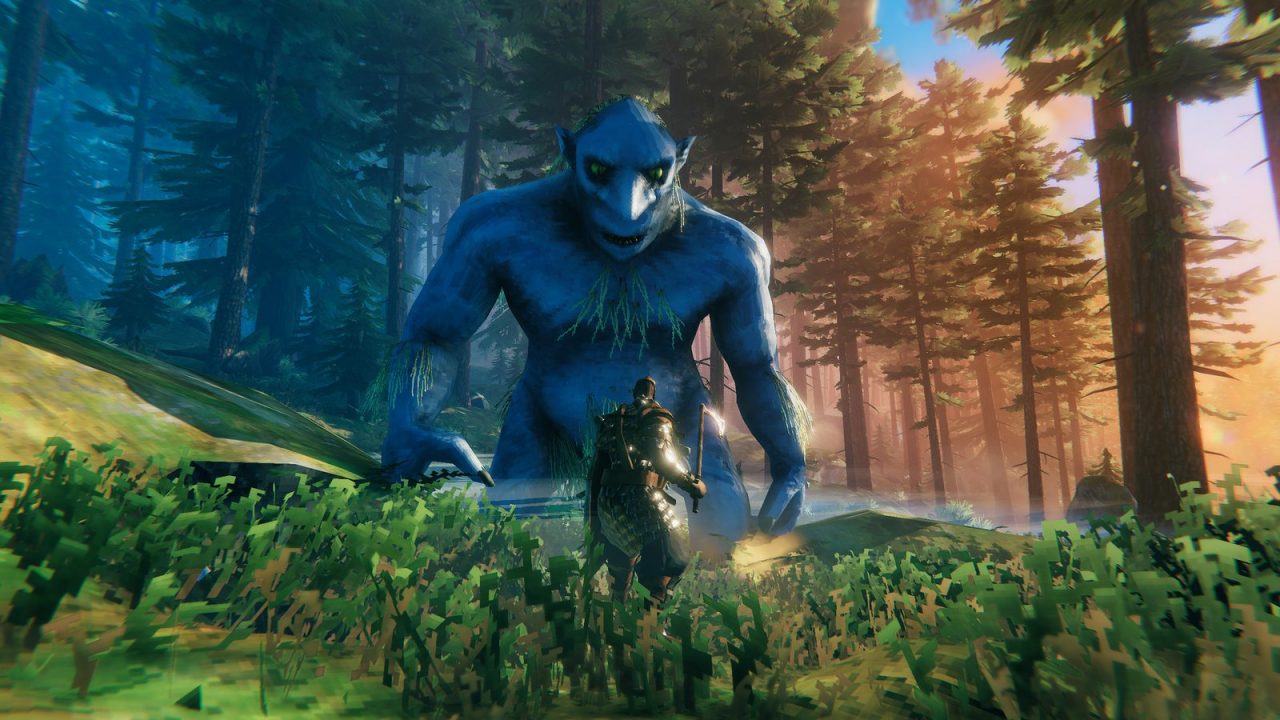
Valheim does not tell you where to go next, but its world is built around a clear sequence. Each biome has its own resources, enemies and boss, and defeating that boss gives you what you need to survive and harvest the next one. Go too far too early and the game punishes you hard: a player in leather armor wandering into the Plains rarely lasts long. Follow the order and the difficulty climbs smoothly from peaceful meadows to burning islands and, since the 1.0 release, a frozen north.
This guide walks through each biome in its intended order. If you are starting your very first world, read our Valheim beginner’s guide first. Specific recipes and numbers can change with updates, so we focus on the role each biome plays.
How Valheim Progression Works
Wikipedia summarizes the core goal: defeat the bosses located in different biomes of the world. Bosses are summoned at altars by offering specific items, and each one drops a trophy you can hang at a central altar to receive a power, plus an item that unlocks the next stage of progression. That second item is the important part. It is usually the key to a new tool, a new crafting station or access to a new material.
The intended order is:
- Meadows
- Black Forest
- Swamp
- Mountains
- Plains
- Mistlands
- Ashlands
- Deep North (added with the 1.0 release on 9 September 2026)
The Ocean sits alongside this list as a travel biome rather than a step in the chain.
Meadows: The Starting Biome
Resources: wood, loose stone, flint near water, leather scraps and deer hide from boars and deer, berries and mushrooms.
Dangers: minimal. Necks along shorelines and occasional Greydwarfs wandering in from nearby forests.
Boss: Eikthyr. Summoned with deer trophies at his altar. His key drop is the hard antler, used to craft the antler pickaxe, your first tool that can mine copper and tin.
Gear tier: flint tools and weapons, leather armor. Set up a first base, a workbench and a bed, and cook meat to boost your health and stamina.
Black Forest: Bronze Age
Resources: copper and tin ore, which are smelted and combined into bronze at a forge; surtling cores from burial chambers, needed for smelters and kilns; and ancient seeds dropped by Greydwarf brutes and shamans.
Dangers: Greydwarfs in numbers, skeletons in burial chambers and trolls, the first enemy that can easily kill an unprepared player.
Boss: The Elder. Summoned with ancient seeds. Its key drop is the swamp key, which opens the sunken crypts of the Swamp.
Gear tier: bronze weapons and armor. The Black Forest is also where many players build their first serious base, since it has the ore needed for the next steps. Blunt weapons work well against skeletons, and fire arrows are a popular choice against The Elder.
Swamp: Iron and the Undead
Resources: iron scraps from sunken crypts, ancient bark, withered bones and more surtling cores.
Dangers: Draugr, leeches in the water, poisonous blobs and oozers and, at night, wraiths. The Swamp is wet and dark, and it is easy to get lost.
Boss: Bonemass. Weak to blunt damage, and his attacks poison, so a poison resistance mead is a common preparation. His key drop is the wishbone, which helps you find buried silver in the Mountains.
Gear tier: iron. The iron pickaxe is especially important, because silver ore cannot be mined without it.
Mountains: Cold and Silver
Resources: silver ore, located with the wishbone; wolf pelts; dragon eggs; obsidian and crystals.
Dangers: freezing cold, which stops passive health regeneration and slows stamina recovery without protection. Wolves, drakes, stone golems and, at night, Fenrings make this one of the most dangerous biomes at its stage.
Boss: Moder. Summoned with dragon eggs. Her drop, dragon tears, unlocks the artisan table and the blast furnace, which you need to work black metal later.
Gear tier: silver weapons, wolf armor or frost resistance mead. Cold resistance is mandatory, not optional. Many players start by finding silver with the wishbone and hauling it out quickly before committing to a full expedition.
Plains: The First Big Difficulty Spike
Resources: black metal scraps from Fuling villages, flax and barley, lox, cloudberries.
Dangers: Fulings in groups, including berserkers and shamans; Deathsquitos, fast flying insects that can kill underprepared players in seconds; and lox, large animals that hit very hard.
Boss: Yagluth. Summoned with Fuling totems from villages. His drop, the torn spirit, is the key to the wisp fountain, which lets you craft the light needed to see in the Mistlands.
Gear tier: black metal weapons, padded armor, linen. Many players consider the Plains the moment Valheim stops being forgiving. Arriving with fully upgraded silver gear and good food is strongly recommended.
Mistlands: Fog, Dwarves and Magic
The Mistlands arrived in a major update in December 2022, which also introduced a magic system.
Resources: Eitr, the magical resource used for magic items; Yggdrasil wood; black marble; black cores from infested mines; and Dvergr items found in their settlements.
Dangers: thick mist that limits vision, Seekers and their soldiers, ticks and the large flying Gjall. The terrain is jagged and confusing.
Boss: The Queen. The sixth main boss, fought inside an infested citadel that you need a crafted key to open. Defeating her opens the path to the Ashlands.
Gear tier: carapace armor and weapons, and Eitr-powered staffs for magic users. Foods that grant Eitr become important if you play a mage.
Ashlands: Fire and Flametal
The Ashlands update launched in May 2024, adding a fully realized volcanic biome and the seventh boss, Fader.
Resources: ashwood, grausten stone, flametal ore and bell fragments from fortresses and ruins.
Dangers: the biome itself, which burns and damages careless players; lava; and the Charred, an army of undead warriors in fortresses and on patrol. Even reaching the Ashlands by sea is a challenge.
Boss: Fader. A skeletal dragon fought in a coliseum after placing bells around it.
Gear tier: flametal weapons and armor, fire resistance. Siege tools, shields and well-defended bases help in the Ashlands, since the Charred attack structures.
Deep North: The Final Biome
For years, the Deep North was the last unfinished biome. Wikipedia notes that after the Ashlands update in May 2024, it was the only biome still in development. It finally arrived with the Valheim 1.0 release on 9 September 2026, which the official Valheim website lists alongside a long set of new additions: more than 40 new weapons, four new armor sets, more than 10 new creatures, more than 80 new buildable pieces, new crafting materials, foods, locations and achievements. Wikipedia lists PlayStation 5 and Nintendo Switch 2 releases alongside 1.0.
As expected from its name, the Deep North is a frozen biome with extreme cold, so the best frost protection you can make is essential. Because it is so new, details are still being explored and patched, so we recommend checking the official patch notes before you plan a final expedition.
The Ocean: Not a Step but a Road
The Ocean connects everything. Serpents attack boats in deep water, and storms make sailing dangerous. Serpent scales and trophies are worthwhile, and later the Ocean holds dormant leviathans whose barnacles yield chitin. Sailing becomes increasingly necessary as you progress, since late biomes are often found on distant islands.
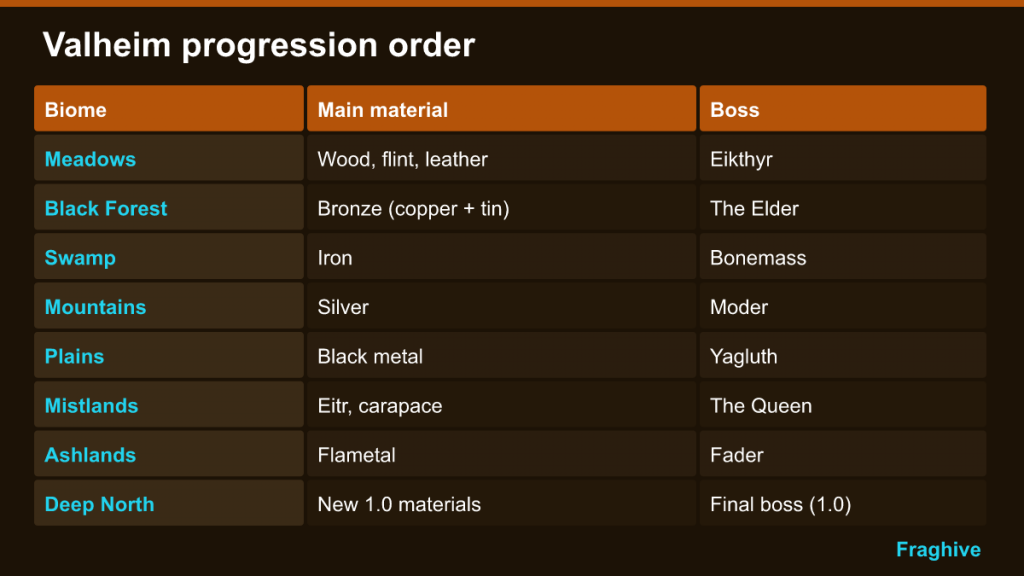
Progression Summary
| Biome | Main material | Boss | What the boss unlocks |
|---|---|---|---|
| Meadows | Wood, flint, leather | Eikthyr | Antler pickaxe (copper and tin) |
| Black Forest | Bronze (copper + tin) | The Elder | Swamp key (sunken crypts, iron) |
| Swamp | Iron | Bonemass | Wishbone (finding silver) |
| Mountains | Silver | Moder | Artisan table, blast furnace |
| Plains | Black metal | Yagluth | Wisp light for the Mistlands |
| Mistlands | Eitr, carapace | The Queen | Path to the Ashlands |
| Ashlands | Flametal | Fader | Path toward the Deep North |
| Deep North | New 1.0 materials | Final boss (1.0) | Endgame |
Pacing Your Progression
There is no timer in Valheim, and the best pace depends on how you play.
Solo players
Playing alone is entirely possible, but it is slower and riskier. A death deep in the Swamp or Plains means a corpse run with no one to cover you. Solo players benefit from building small forward bases with a bed, a portal and a fire near each new biome, and from bringing a spare set of basic gear for recovering a tombstone.
Groups
Valheim supports up to ten players on a server. Groups move faster and can split jobs: one player smelts and crafts at home, others mine or hunt. But enemies and bosses also become tougher as more players are nearby, so a large group does not make every fight trivial.
When to move on
A good signal that you are ready for the next biome is when your current gear is fully upgraded, you have a reliable food supply from the current biome and you have the resistance item the next biome needs. If the boss of your current biome still feels terrifying, you are probably not ready to leave yet.
Common Progression Mistakes
- Skipping food. Valheim’s health and stamina come mostly from food. Eating the best foods available in your current biome matters more than almost anything else.
- Entering a biome without the right resistance. Frost in the Mountains, poison in the Swamp and fire in the Ashlands require preparation.
- Fighting a boss too early. Bosses scale with the stage of the game. Fully upgrade your current gear before summoning the next one.
- Ignoring portals. Portals save hours of travel, but on default settings metal ore cannot pass through them, so build forward bases or plan ore runs by boat or cart.
- Exploring alone at night. Many biomes become far more dangerous after dark.