Zone Strategy in Battle Royale: How to Rotate and Survive the Circle
How shrinking zones work in Fortnite, Apex, Warzone and PUBG, and how to decide when to rotate, where to stand and how to avoid third parties.
In every battle royale, the map is slowly taken away from you. Fortnite calls it the storm, Apex Legends the ring, Warzone the circle or gas and PUBG the blue zone. The names change, but the job is the same: push surviving players closer together until only one player or team is left. Many matches are not lost in a gunfight at all. They are lost by being in the wrong place when the zone moves, by arriving too late to find cover or by walking into a fight between two other teams on the way in.
This guide explains how zone mechanics work, how to decide when to move, where to position yourself once you arrive and how to reduce the risk of getting third-partied. The principles apply to all four major games, with game-specific notes along the way. If you need a refresher on the genre’s basic structure first, start with what a battle royale game is.
How Shrinking Zones Work
Every battle royale zone follows the same cycle:
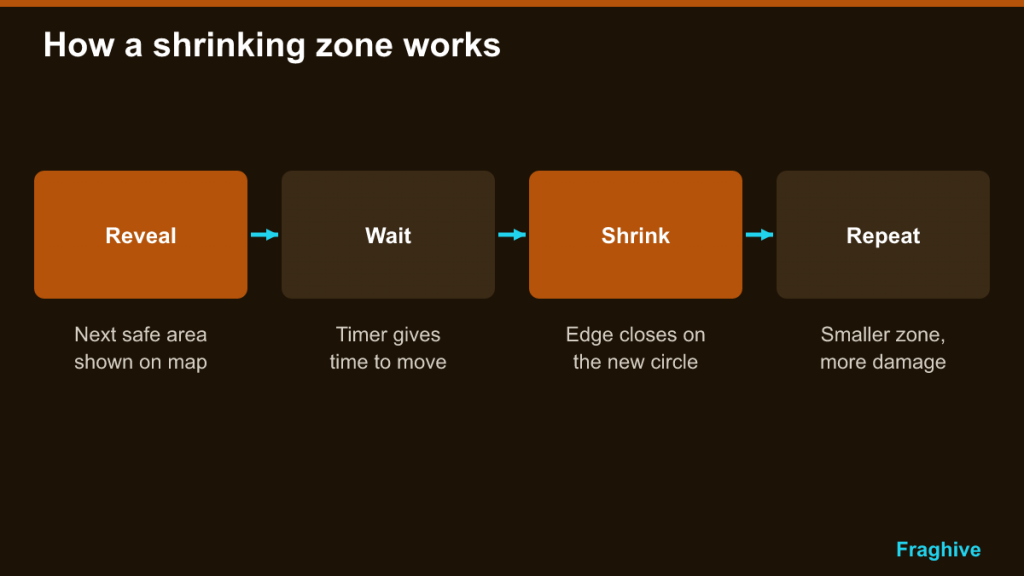
- Reveal. The game shows where the next safe area will be, usually as a circle on the map inside the current one.
- Wait. A timer counts down while players have time to move.
- Shrink. The outer edge closes toward the new circle.
- Repeat. Each later phase is smaller, and usually more dangerous outside it.
Players caught outside the safe area take damage over time, and in all four games that damage generally increases as the match goes on. Early zones are survivable for a while; late zones can eliminate you in seconds. That is why the same mistake, being outside the zone, can be harmless in the first phase and fatal in the last.
Game-specific notes
- Fortnite: the safe area is the eye of the storm. Players outside take increasing damage as the match continues.
- Apex Legends: the ring closes in stages. Legends in the Controller class can use Ring Consoles to reveal where the next ring will be before it is shown to everyone, which makes early rotations much easier.
- Warzone: the circle closes with a gas cloud, and the large maps make vehicles and redeploy options important for long rotations.
- PUBG: the blue zone shrinks in phases and deals incremental damage to players outside. Separately, the red zone marks random areas that are bombarded after a warning, a reason never to linger in the open in a red-highlighted region.
The exact damage values and timers vary by game, mode and season and are adjusted often, so this guide focuses on decisions rather than numbers.
The Core Decision: Move Early or Move Late?
Every zone phase forces a choice between rotating early and rotating late. Neither is always right.
Rotating early
Moving as soon as the next zone is revealed gives you first pick of positions. You can claim a building, a ridge or a cluster of rocks inside the new circle and wait for others to come to you.
- Pros: strong position, time to heal and reorganize, enemies have to approach you across open ground.
- Cons: you may run into teams already there, and you leave loot behind. If the zone after that pulls away from your spot, you have to move again.
Rotating late
Staying near the edge until the zone starts closing, then moving in behind it, is often called “edge play” or “riding the zone”.
- Pros: you only have to watch one direction, because the zone protects your back. Other teams have already fought each other ahead of you.
- Cons: you arrive to find the good positions taken, you may get pinned in the open and a late fight can leave you stuck outside the zone taking damage.
A simple rule of thumb
If you are far from the next zone, have no vehicle or mobility, or the zone is likely to cover open terrain, move early. If you are close to the zone, already have good cover and know enemies are between you and the center, edge play can be safer. Many strong players mix both: move early into a defensible area near the edge, then decide later whether to push deeper.
Edge vs Center: Where to Stand
Playing the edge
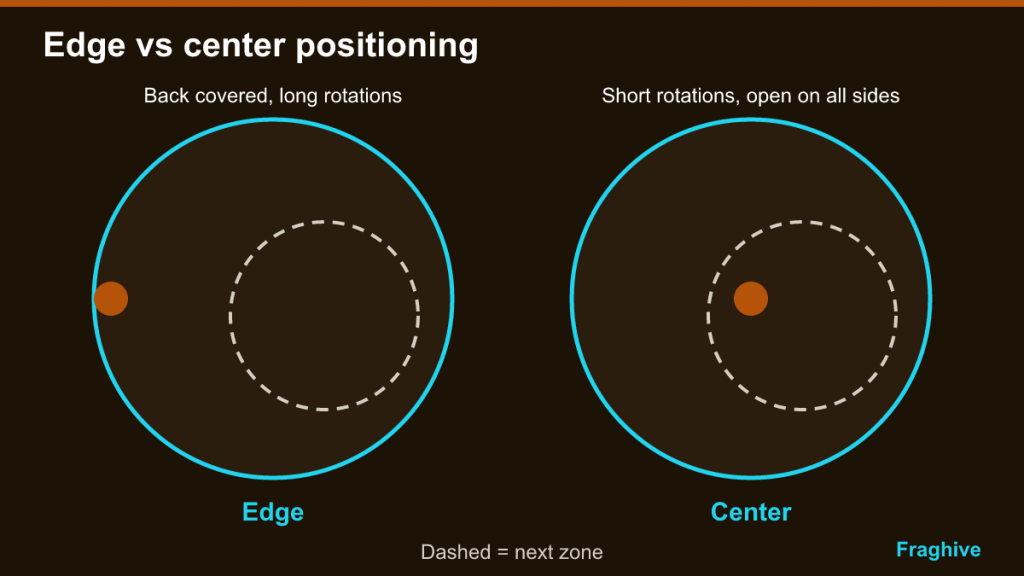
The edge of the zone is the safest place to be when most teams are still alive. Your back is covered by the zone itself, so threats can only come from inside the circle. The downside is that if the next zone pulls away from you, you face the longest possible rotation.
Playing the center
Holding the center means every future zone is close to you, so you rarely need long rotations. The downside is exposure: teams can approach you from every direction, and you are likely to hear several fights around you. Center positions are only strong if you have solid cover, like a building, and enough healing to hold it.
The middle ground
A popular compromise is to take a position that is inside the next zone but on the side closest to you. You stay near the edge, but you are already inside the following circle, so the next shrink does not force you to move.
High Ground, Cover and Sight Lines
Positioning matters as much as timing. A few universal principles:
- High ground wins information. From a hill or rooftop you can see rotating teams before they see you and choose your fights.
- Hard cover beats soft cover. Buildings, rocks and terrain stop bullets reliably. Bushes and trees hide you but often do not protect you.
- Know your exits. A strong spot with only one way out can become a trap when the next zone moves.
- Avoid low ground late. In the final circles, teams on low ground can be shot from multiple angles with nowhere to hide.
In Fortnite’s Build modes, players can create their own cover and high ground, which is why late zones often turn into building battles. In Zero Build, Apex, Warzone and PUBG, terrain and buildings are fixed, so planning the next position ahead of time becomes even more important.
Vehicles, Mobility and Long Rotations
When the zone pulls across the map, your mobility options decide your route.
- PUBG relies heavily on vehicles. Large maps make long rotations on foot dangerous, and a car can carry a squad through open fields quickly. Vehicles are also loud and visible, so leave them before your final position rather than driving right up to it. Our PUBG beginner’s guide covers vehicles in more detail.
- Warzone maps also have vehicles, and redeploy options can help reposition. Like PUBG, vehicles attract attention.
- Apex Legends relies on movement and Legend abilities: zip-lines, jump towers and the abilities of Skirmisher Legends. Our Apex classes guide explains which Legends help most with rotations.
- Fortnite offers a changing mix of vehicles and mobility items depending on the season, and in Build modes, ramps can carry you over obstacles.
The general rule: if you need to cross a lot of open ground, do it early, before other teams are already settled in the next zone and watching it.
Third Parties: The Biggest Rotation Risk
A third party happens when a team attacks two other teams already fighting each other. The newcomer hits weakened players who are low on health, shields or ammo. Third parties are one of the main reasons rotations go wrong.
How to avoid getting third-partied
- End fights quickly or disengage. Long fights make noise and attract attention. If a fight is going nowhere, back off.
- Heal and reload immediately after a fight. Then move. Staying in place to loot everything is how teams get caught.
- Do not rotate through active fights. If you hear gunfire on your route, take a detour if the zone allows it.
- Watch the routes others will use. Natural chokepoints, such as bridges and gaps between hills, are where teams meet.
When to be the third party
Third-partying is also a valid strategy. If you can see two teams fighting and you are healthy, attacking after the fight has worn them down can earn easy eliminations and loot. The risk is that a fourth team does the same to you, so stay alert even when you are winning.
Final Circles: Patience and Positioning
The final zones play differently from the rest of the match. Space is limited, everyone knows roughly where everyone else is and every movement can be seen.
- Make every move count. Plan your next position before the zone shrinks so you can move in one go rather than in small exposed steps.
- Keep healing items ready. Late zones deal heavy damage, and sometimes the best move is to take a little zone damage to reach better cover.
- Let others fight. If two teams are trading shots and you are safe, let them weaken each other.
- Count teams. Know how many teams and players remain and roughly where they are. A final circle with three teams is a different puzzle from one with ten.
Common Zone Mistakes
- Looting too long. The most common cause of zone deaths. Grab the essentials and move.
- Ignoring the timer. Always know how long you have before the zone closes and how long your route takes.
- Running in a straight line across open ground. Use cover, even if it takes a little longer.
- Underestimating late zone damage. Damage that was harmless early in the match can eliminate you late. Do not plan to “tank” late zones.
- Not planning two zones ahead. A spot that is perfect now is useless if the next zone pulls away and you cannot leave safely.