Minecraft vs Rust vs Valheim vs Ark: Which Survival Game Should You Play?
Difficulty, PvP vs co-op, building, progression, platforms and time commitment compared across Minecraft, Rust, Valheim and ARK, with picks by player type.
Minecraft, Rust, Valheim and ARK all belong to the survival crafting family: you start with almost nothing, gather resources, craft better tools, build a base and push into more dangerous territory. Yet they deliver very different experiences. One is a gentle, endlessly creative sandbox. One is a brutal online world where other players are the main threat. One is a co-op Viking adventure with boss fights. One is about taming dinosaurs. Choosing the wrong one can mean bouncing off a genre you might otherwise love.
This comparison looks at what each game asks of you and gives you, with a table and recommendations by player type. Platform and release details are checked against each game’s Wikipedia entry and official sites as of October 2026. For a broader look at the genre’s shared mechanics, see our survival crafting genre explainer.
The Four Games in a Nutshell
Minecraft
Mojang Studios’ block-based sandbox is the best-selling video game of all time, with more than 400 million copies sold as of May 2026, according to Wikipedia. Survival mode asks you to gather, craft and survive hostile mobs at night, but you can also play in Creative mode with unlimited resources. It exists as Java Edition on PC and Bedrock Edition across consoles, mobile and Windows.
Rust
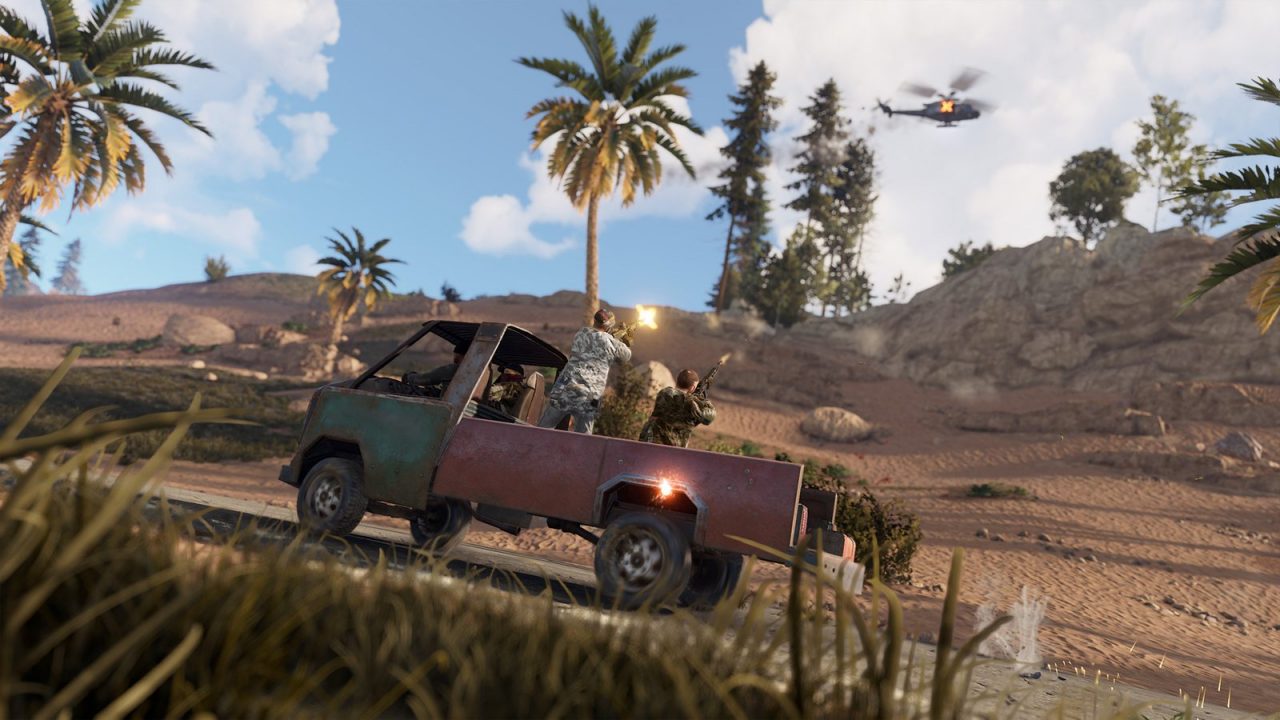
Facepunch Studios’ Rust entered early access on 11 December 2013 and fully released on 8 February 2018. Players spawn with only a rock and a torch on an island full of other players. Raiding is a major part of the game, and servers are periodically wiped, which resets bases. A console edition exists, with native PlayStation 5 and Xbox Series X/S versions fully released in June 2025.
Valheim
Iron Gate Studio’s Viking survival game, published by Coffee Stain, launched in early access on Steam on 2 February 2021 and sold more than five million copies within about a month. It supports up to ten players per server in co-op, with optional PvP. Wikipedia lists the full 1.0 release on 9 September 2026, for PC, PlayStation 5 and Nintendo Switch 2; Xbox versions arrived in early access in March 2023.
ARK: Survival Ascended
Studio Wildcard’s Unreal Engine 5 remaster of ARK: Survival Evolved launched in early access on PC in October 2023, followed by Xbox Series X/S on 21 November 2023 and PlayStation 5 on 30 November 2023. Its defining feature is taming creatures, especially dinosaurs, to ride, fight and work for you. Wikipedia reports 4 million copies sold as of May 2026.
Comparison Table
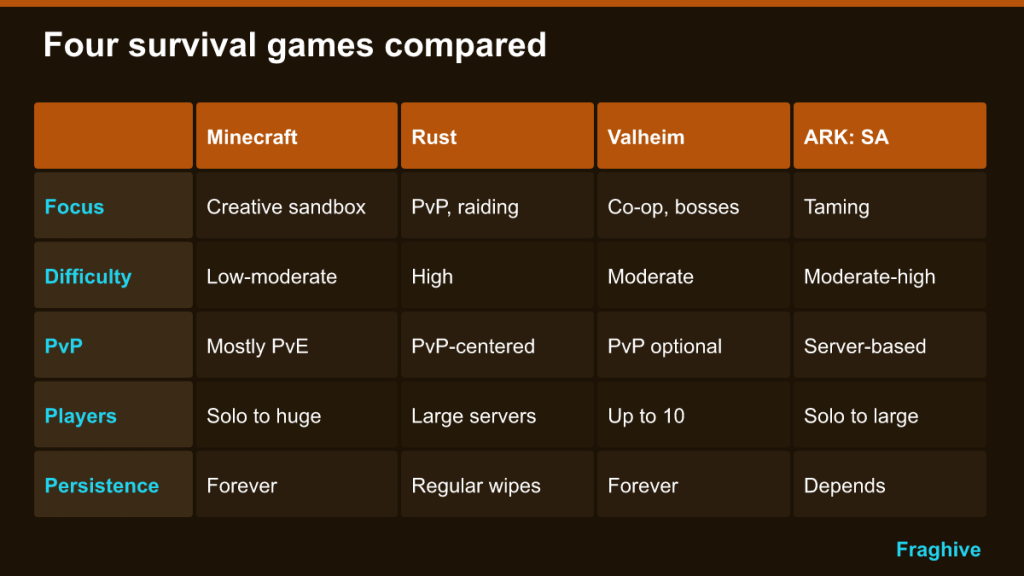
| Minecraft | Rust | Valheim | ARK: Survival Ascended | |
|---|---|---|---|---|
| Core focus | Creative sandbox and exploration | PvP survival and raiding | Co-op exploration and bosses | Taming and creature-based survival |
| Difficulty | Low to moderate (adjustable) | High (other players) | Moderate, rising with biomes | Moderate to high, grind-heavy |
| PvP vs PvE | Mostly PvE; PvP on servers | PvP-centered | PvE co-op; PvP optional | Both, depending on server |
| Building depth | Extremely deep, block by block | Functional, defense-focused | Physics-based structural integrity | Large modular bases |
| Progression | Tool tiers, dimensions, Ender Dragon | Blueprints and tech tree per wipe | Biome by biome, boss-gated | Levels, engrams and tames |
| Players | Solo to huge servers | Large online servers | Up to 10 per server | Solo to large servers |
| Persistence | Worlds last forever | Regular wipes | Worlds last forever | Depends on server |
| Platforms (Oct 2026) | PC, consoles, mobile | PC; console edition | PC, Xbox, PS5, Switch 2 | PC, Xbox Series X/S, PS5 |
Difficulty and Danger
Minecraft is the most forgiving. You can choose Peaceful, Easy, Normal or Hard difficulty, or switch to Creative entirely. Dying usually means losing the items you carried, which you can often recover. It is a superb first survival game.
Valheim starts gently in the Meadows, then escalates as you move into each new biome. Death drops your gear at a tombstone, and retrieving it from a dangerous area is a classic Valheim challenge. Difficulty is shaped largely by the game’s monsters and environment, not other players.
ARK is dangerous in a different way. Large predators can kill an unprepared player very quickly, and losing a tamed creature you spent hours on can be painful. In single-player and on custom servers, many settings can be adjusted to make the experience gentler.
Rust is the hardest, because the main danger is other people. Fresh spawns are often killed by better-equipped players, and bases can be raided while you sleep. The game is built around that tension, and most new players die many times before they keep a base for long.
PvP, Co-op and the Social Side
How you want to play with others is the most important question in this comparison.
- Want to play mostly with friends, against the world? Valheim is designed for it: small groups, cooperative bosses and no pressure from strangers unless you enable PvP.
- Want a big shared world? Minecraft servers range from small friend groups to huge public networks with minigames. ARK also supports large servers, with official and unofficial options.
- Want competition, alliances and betrayal? Rust is the clear choice. Interaction with other players, friendly or not, drives the experience.
- Want to play alone? Minecraft, Valheim and ARK all work well solo. Rust is possible solo but much harder, and it is best on servers with group limits or low population.
Building and Creativity
Minecraft is in a class of its own for creativity. Every block can be placed anywhere, and players build everything from cottages to working computers with redstone. Creative mode removes all limits.
Valheim has some of the most satisfying building in the genre. Structures must be supported properly, with stronger materials and support beams required for tall buildings, and good-looking Viking halls are a common goal for groups.
ARK offers large modular bases, with additional structures for housing and breeding creatures. Bases often need to be big to accommodate dinosaurs.
Rust treats building mainly as defense. Bases are designed around protecting loot from raiders, with layered walls, airlocks and tool cupboards. Creativity exists, but survival comes first, and every wipe sends your work back to zero.
Progression Structure
Each game has a different way of moving you forward:
- Minecraft: tool tiers from wood to stone, iron, diamond and netherite, then the Nether and the End with the Ender Dragon as the traditional finale. But there is no requirement to “finish” anything.
- Valheim: a clear sequence of biomes, each requiring better gear. Bosses unlock key materials and grant power-ups when their trophies are placed at the central altar. Our Valheim beginner’s guide covers the early steps.
- ARK: character levels unlock engrams (crafting recipes), and taming stronger creatures opens up more of the map and more dangerous challenges, including bosses.
- Rust: blueprints and a workbench tech tree, earned with scrap. Progression restarts on blueprint wipes, so it is a cycle rather than a straight line.
Server Options
Where you play matters almost as much as what you play.
- Minecraft offers single-player worlds, local multiplayer, Realms subscriptions for small private groups and a huge ecosystem of community servers. Java and Bedrock use separate server ecosystems, so check which edition a server supports.
- Rust is played on official and community servers, each with its own wipe schedule, group limits and rules. Community servers range from vanilla to heavily modded, and choosing a low-population or solo/duo server changes the experience completely.
- Valheim worlds can be hosted from your own game for friends or run on a dedicated server, and the world persists between sessions. With a ten-player cap, it is built for small communities.
- ARK: Survival Ascended has official servers, unofficial community servers and single-player. Unofficial servers and single-player let you change taming speed, experience rates and more, which can turn a long grind into something manageable.
Time Commitment
All four games can absorb hundreds of hours, but they differ in how much they demand at once.
Minecraft is the most flexible. You can play for twenty minutes and stop, and your world will be exactly as you left it.
Valheim fits regular sessions with a group. Progress is permanent, and adventures into new biomes take a few hours each.
ARK is notoriously grind-heavy. Taming large creatures can take a long time, and breeding projects take even longer. Server settings for single-player can speed this up dramatically.
Rust demands the most consistent time. Because of wipes and raids, players who log in daily have a major advantage, and a base you cannot defend or maintain may not survive your absence.
Which One Should You Play?
New to survival games
Start with Minecraft. It teaches the genre’s fundamentals at your own pace, runs on almost anything and offers more freedom than any other game here.
Small group of friends
Pick Valheim. It is built for co-op, has a clear sense of progression and adventure and leaves your world intact between sessions.
Dinosaur and creature fans
Pick ARK: Survival Ascended, ideally starting in single-player or on a friendly server to learn taming before facing other tribes. Our ARK beginner’s guide covers the first tames.
Competitive players who want stakes
Pick Rust, but be ready to lose often at first, and consider a low-population or group-limited server.
Frequently Asked Questions
Which game has the best building? Minecraft for pure creativity, Valheim for satisfying structural building, Rust for defensive design.
Which is best on console? Minecraft has the widest support. Valheim, ARK: Survival Ascended and Rust Console Edition are available on current consoles, with differences in features and server options compared with PC.
Can I play any of these without other people? Yes for Minecraft, Valheim and ARK. Rust is built around online servers and is not designed as a single-player experience.