Apex Legends Classes Explained: Assault, Skirmisher, Recon, Support and Controller
How the five Apex Legends classes work, what each class perk does in Battle Royale and how to combine classes into a balanced trio.
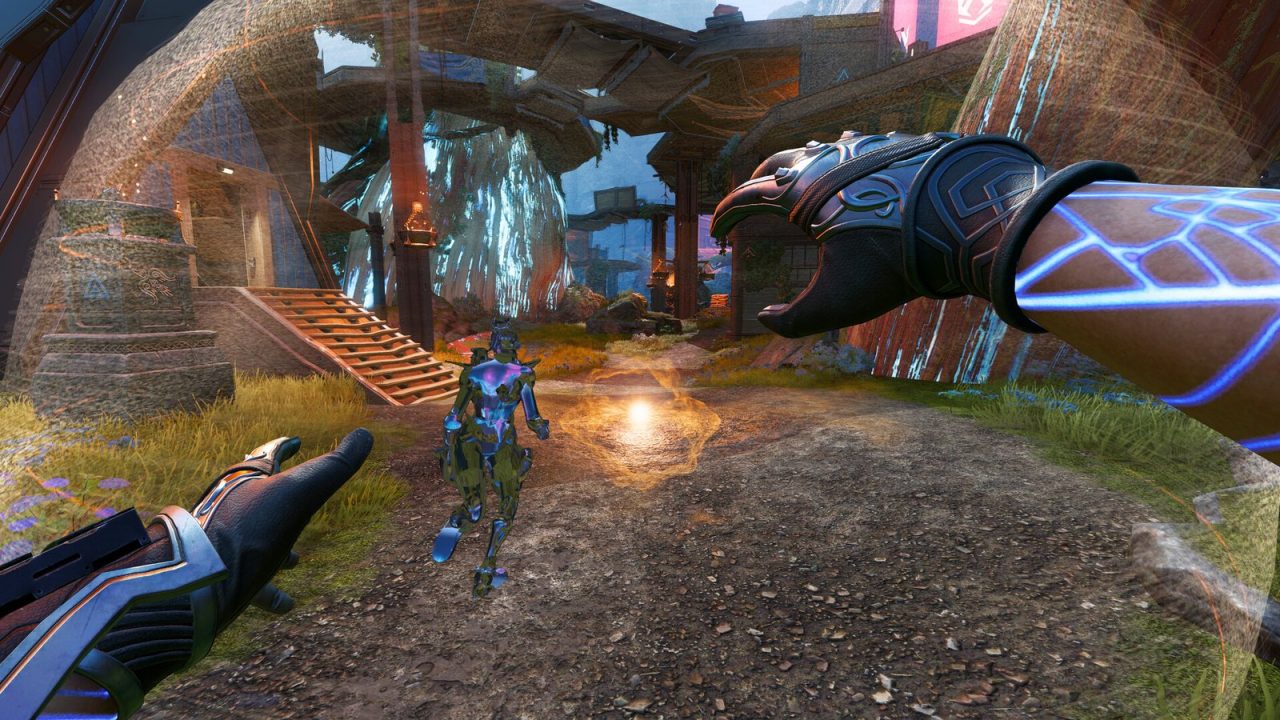
Every Legend in Apex Legends has a unique kit of abilities, but they also belong to a wider group called a class. The class does two jobs. It tells you, at a glance, what role a Legend is built for, and in Battle Royale it gives that Legend a shared class perk that interacts with the map: special loot bins, survey beacons, ring consoles or care packages. Understanding the five classes makes Legend selection faster, helps you build a squad that covers its weaknesses and explains why some teams always seem to know where the ring is going.
This guide covers how the system came about, what each class is for, the kinds of perks each class receives and how to combine them. Perk details are tuned regularly, so we focus on the stable core of each class rather than exact numbers. If you are brand new, start with our Apex Legends beginner’s guide first.
How the Class System Came About
Apex Legends launched on February 4, 2019, on PC, PlayStation 4 and Xbox One, developed by Respawn Entertainment and published by Electronic Arts. From the start, Legends were loosely described by role, but only one group had a real gameplay perk for most of the early years. According to the community-maintained Apex Legends wiki, the Recon class perk was introduced on August 18, 2020: Recon Legends could use survey beacons to reveal where the next ring would close.
The big change came with Season 16, “Revelry”, on February 14, 2023. Respawn reworked the class system, sorted every Legend into one of five classes (Assault, Skirmisher, Recon, Support and Controller) and gave each class its own perk. Wikipedia’s article on the game also notes that from Season 16 onward each Legend belongs to one of these five classes. Revelry was also the first season that did not add a new Legend; until then a new character had arrived every season.
In that rework, the ring-revealing ability moved away from Recon. Controllers gained access to Ring Consoles to see the next ring, while Recon Legends received a new use for survey beacons: scanning for enemy positions. Since then, Respawn has adjusted perks in many seasons, and a few Legends have changed class. Pathfinder is the most-moved example: the wiki records him starting as Support, moving to Recon in Season 4 and becoming a Skirmisher in Season 16.
Assault: Frontline Fighters
Assault Legends are built to start and win gunfights. Their abilities typically create pressure: smoke, ordnance, damage zones, aggressive repositioning. Examples include Bangalore, Revenant, Fuse, Mad Maggie and Ballistic.
Class perk focus: loot and ammunition for sustained fighting. Assault Legends can open a hidden compartment in weapon supply bins (the red-marked bins) that holds better attachments, and they carry more ammo per inventory slot. The wiki also lists extra slots for grenades and faster handling of stowed weapons among current Assault perks. The point is simple: Assault players should be the ones with full weapons and enough ammunition to keep shooting when a fight drags on.
Playing Assault well: take the first engagement, use abilities to break enemy cover and lead the push when teammates create an opening. Assault players who play passively waste their kit.
Skirmisher: Mobile Fighters
Skirmishers are about movement and repositioning. They get into fights fast, and just as importantly, they get out. Typical tools include grapples, portals, jump pads, gravity lifts and dimensional rifts. Examples include Pathfinder, Wraith, Octane, Horizon, Ash and Alter.
Class perk focus: care packages. Skirmishers can see what a care package contains from a distance, so the team can decide whether a high-tier item is worth contesting, and they can tell whether it has already been looted. That information matters because care packages drop in contested spots; walking up to an empty one is how squads get third-partied.
Playing Skirmisher well: treat your mobility ability as the squad’s escape plan as well as an attack tool. Many good Skirmisher players hold a cooldown in reserve during a fight specifically to reposition the team if things go wrong.
Recon: Information Gatherers
Recon Legends track enemies and gather information. Their kits often include scans, sight lines, drones or tracking abilities. Examples include Bloodhound, Crypto, Valkyrie, Seer, Vantage and Sparrow.
Class perk focus: survey beacons. When a Recon Legend scans a beacon, nearby enemy positions are revealed for a short time, and the community wiki notes that enemies are alerted when they are scanned. Since the 2023 rework this has been the defining Recon tool: you learn where teams are sitting before you commit to a rotation.
Playing Recon well: scan with a question in mind. “Is the building we want to take occupied?” or “Who is between us and the next zone?” are good reasons to scan. Calling out what you see with the ping system is as important as the scan itself, because the information only helps if the squad acts on it.
Support: Keeping the Squad Alive
Support Legends heal, protect and bring teammates back. Their kits include healing drones, shields, revives and resupply. Examples include Gibraltar, Lifeline, Mirage, Loba, Newcastle and Conduit.
Class perk focus: recovery and respawns. Support Legends can open extra compartments in supply bins for healing items, and in the Season 16 rework they gained the ability to craft banners for fallen allies at Replicators, even after the banner has expired. Later updates added revive-related bonuses such as health regeneration on revives. If a teammate is lost late in a match, the Support player is often the one with the tools to bring them back.
Playing Support well: stay close enough to your team to revive and heal, but not so close that one grenade knocks all three. Keep an eye on teammate banners and remember the crafting option before you give up on a dead squadmate.
Controller: Owning Space
Controllers lock down areas: traps, fences, gas, walls and barricades. They shine when the team holds a building or a strong position. Examples include Caustic, Wattson, Rampart and Catalyst.
Class perk focus: Ring Consoles. Controllers can use these map consoles to reveal where the next ring will close. That lets the squad move to good positions in the next zone early, before other teams arrive, and set up the defenses Controllers are good at.
Playing Controller well: use the console early in each ring phase and pick a building or high ground inside the next circle. Controllers are weakest in open, rotating fights and strongest when enemies must come to them.
The Five Classes at a Glance
| Class | Core role | Map interaction | Example Legends |
|---|---|---|---|
| Assault | Start and win fights | Hidden compartment in weapon bins, extra ammo | Bangalore, Fuse, Mad Maggie |
| Skirmisher | Mobility and repositioning | See care package contents | Pathfinder, Wraith, Octane |
| Recon | Find enemies, gather info | Survey beacons reveal enemies | Bloodhound, Seer, Vantage |
| Support | Heal, revive, respawn | Extra supply bin loot, banner crafting | Lifeline, Gibraltar, Loba |
| Controller | Hold and deny space | Ring Consoles reveal next ring | Caustic, Wattson, Catalyst |
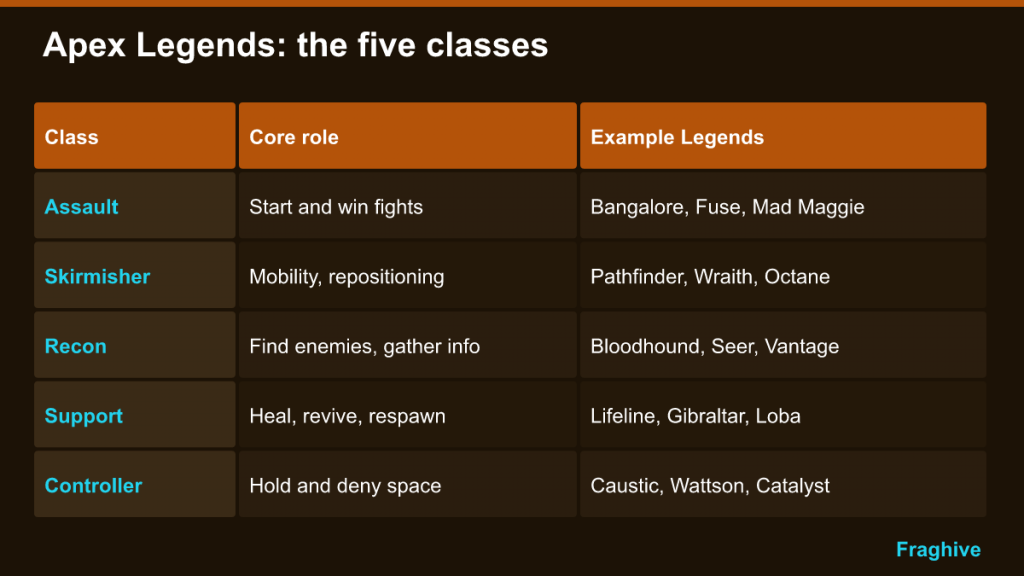
Class membership as listed on the community Apex Legends wiki, October 2026. Respawn occasionally moves a Legend between classes, so check the in-game Legend screen if in doubt.
Building a Balanced Squad
Apex Legends Battle Royale is played mainly in trios, which means three classes at most. You cannot cover everything, so the real question is what your team needs most.
Cover information, mobility and sustain
A reliable starting shape is one information source (Recon or Controller, for the beacon or the ring console), one mobility option (Skirmisher) and one fighter or sustain Legend (Assault or Support). This gives you a way to know where enemies or the ring are, a way to escape bad positions and either firepower or recovery.
Ring information versus enemy information
Controller and Recon perks answer different questions. Ring Consoles tell you where to go; survey beacons tell you who is in the way. Teams that like to rotate early and hold buildings tend to value Controllers. Teams that like to hunt or avoid fights tend to value Recon.
Avoid doubling up on the same weakness
Three Assault Legends can win fights quickly but have no plan when they are caught in the open. Three Controllers can hold a building but struggle to reach it if the ring pulls far away. A squad with no Skirmisher often lacks a clean escape.
Example combinations
- Aggressive: Assault + Skirmisher + Recon. Find the enemy, get there fast, win the fight.
- Zone-focused: Controller + Support + Skirmisher. Read the ring early, take a strong spot, keep everyone alive, reposition if needed.
- Beginner-friendly: Support + Recon + Assault. Forgiving sustain, clear information and simple damage abilities.
These are starting points, not rules. The best squad is often the one where each player is comfortable on their Legend.
Common Mistakes With Classes
- Ignoring the perk entirely. A Controller who never uses a Ring Console or a Recon who never scans a beacon is giving away a free advantage.
- Using the perk at the wrong time. Scanning a beacon while the squad is already in a fight wastes time. Use the information before you commit.
- Not communicating results. Class perks provide team information. Ping the next ring, the enemy positions or the care package contents so everyone sees them, which the game’s ping system makes easy without voice chat.
- Picking by class alone. Classes describe broad roles, but two Legends in the same class can play very differently. Wraith and Octane are both Skirmishers, yet one excels at defensive escapes and the other at personal speed.
- Assuming perks never change. Respawn adjusts perks from season to season. Read the patch notes when a new season starts.
Do Classes Matter Outside Battle Royale?
Class perks are designed around Battle Royale objects such as supply bins, beacons, consoles and care packages, and the community wiki notes that class perks apply in Battle Royale. In arena-style or limited-time modes, the class label is still useful as a description of a Legend’s role, but the perks themselves may not appear. For the broader rules of the genre, including how respawns and zones work in other games, see our explainer on what a battle royale game is.