Rust for Beginners: How to Survive Your First Hours
Waking up with a rock and a torch in Rust: gathering, first tools, sleeping bags, a starter base with a tool cupboard, other players, and choosing a server.
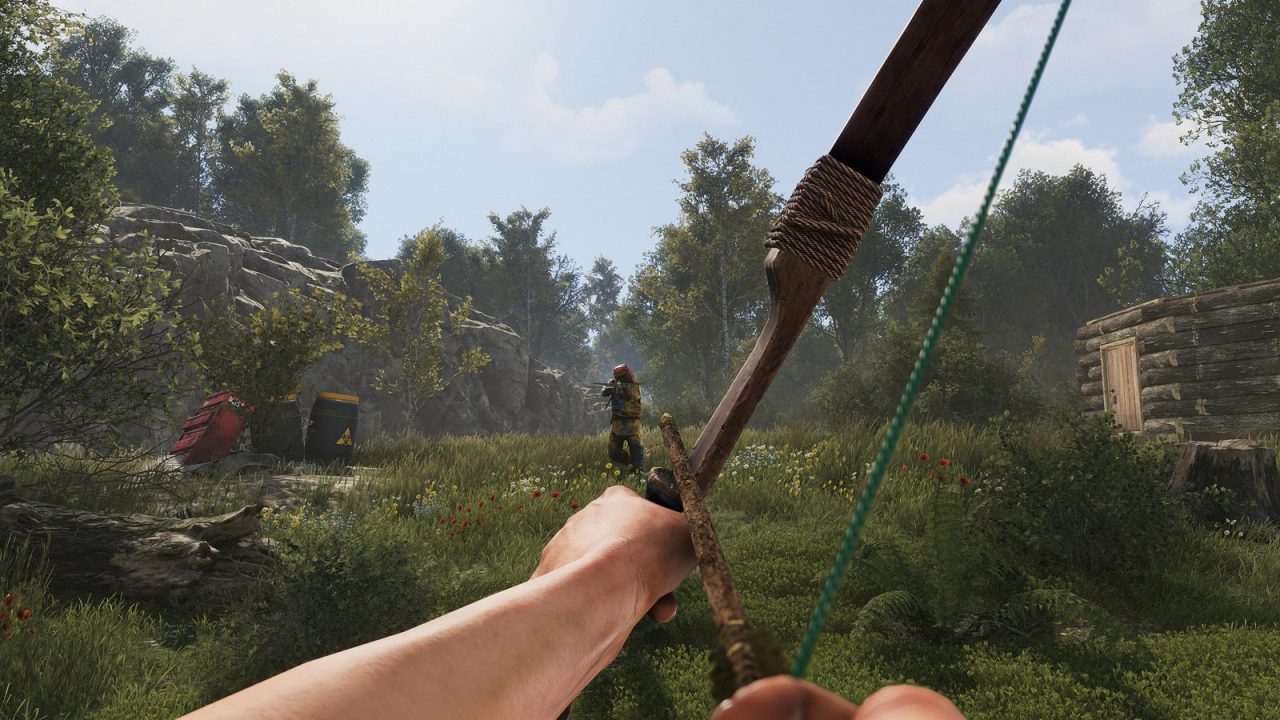
Rust has a famous reputation for being brutal to newcomers. You wake up on a beach with nothing but a rock and a torch, everything around you can kill you, and the other survivors are often the most dangerous thing on the island. Facepunch’s own site sums it up: “The only aim in Rust is to survive.” The good news is that the first hours follow a predictable pattern. Once you understand what to gather, what to build first and how the tool cupboard protects your base, Rust becomes far less chaotic. This guide covers exactly that, plus how to pick a server that gives you room to learn.
Pick the right server before anything else
Your server choice shapes your first hours more than any other decision. Rust runs on thousands of servers, broadly in three groups:
- Official servers are run by Facepunch and follow the default rules.
- Community servers are run by third parties but keep vanilla gameplay. Many advertise their wipe schedule, group limits and rules.
- Modded servers change the game: faster gathering rates, bigger stack sizes, teleport commands, kits, PvE-only rules and more.
For a first playthrough, consider:
- Low population. Fewer players means fewer people roaming the beaches looking for easy targets.
- A recent wipe. On a freshly wiped server, everyone starts from scratch. Joining near the end of a wipe cycle means facing players with guns and stone bases while you hold a rock.
- Group limits. Servers with “solo/duo/trio” limits keep huge clans from dominating.
- PvE servers. If you mainly want to learn crafting and building, a PvE server removes player combat entirely. It is a good classroom, even if it is not the full Rust experience.
Rust also has a guided Tutorial Island. According to the official Rust wiki, it walks new players through about their first half hour: movement, crafting, building and upgrading, respawning, combat, looting, cooking, furnaces, workbenches and vehicles. It only works on servers that enable it, which can be found with the “tut” tag in the server browser.
Waking up: the rock and the torch
Every new character spawns with a rock and a torch. The rock is a tool and a weapon: you can hit trees for wood and stone nodes for stone with it. The torch gives light at night and can be swung as a weak weapon.
You also need to manage health, hunger, thirst and temperature. Cold nights and water drain you quickly, so do not swim or hang around in the dark for long while you have no clothes.
Your first moves should be:
- Leave the open beach. Fresh spawns are easy targets for players who patrol the coastline.
- Hit trees with the rock until you have a few hundred wood.
- Hit stone nodes (gray rocks with flecks on them) for stone.
- Pick up hemp plants, which give cloth. Cloth is needed for sleeping bags, basic clothing and bandages.
Your first crafts
Open the crafting menu and you will see what you can make with your current resources. Early priorities:
- Stone hatchet and stone pickaxe. Both gather far faster than the rock. The hatchet is for trees, the pickaxe for stone and ore nodes.
- A spear or a bow. A wooden spear is cheap. A hunting bow with arrows lets you hunt animals and defend yourself at range.
- Sleeping bag. This is arguably your most important early item (see below).
- Bandages. Made from cloth; they stop bleeding and give a small heal.
- Basic clothing. Even simple burlap clothing reduces how fast you lose heat at night.
Advanced items need a workbench and a blueprint. Blueprints are recipes you research or learn; whether they carry over after a server reset depends on that server’s wipe rules.
Sleeping bags: your respawn points
When you die in Rust, your body stays where it fell with your whole inventory, and you respawn either at a random beach location or at a sleeping bag or bed you own. That makes sleeping bags essential:
- Place one in a hidden spot early, such as behind rocks or in bushes, so a death does not send you back to a random beach.
- Once you build a base, put bags inside it.
- Place a couple in different areas of the map so you have options.
Sleeping bags have a respawn cooldown after use, so having more than one gives you flexibility.
Your first base and the tool cupboard
A tiny base is far more useful than a big one you never finish. The classic starter is a small two-by-one or two-by-two footprint with a single door, built away from roads, monuments and the coast.
Building plan and hammer
Craft a building plan to place foundations, walls, doorways and floors. New pieces start in the weakest state, called twig. Craft a hammer to upgrade them to wood, then stone and higher tiers. Twig and wood can be destroyed quickly by other players, so stone is a meaningful milestone.
Doors and locks
Place a door in the doorway as soon as possible, and add a key lock or a code lock. A base without a locked door is just storage for whoever walks by.
The tool cupboard (TC)
The official Rust wiki describes the tool cupboard as “a very important building item.” It costs 1,000 wood and does two jobs:
- Building privilege. Players authorized on the TC can build, upgrade and pick up deployables within its radius. Unauthorized players are blocked from building most pieces on or near your base (they can still place twig floors and wooden ladders). The radius is projected from the foundations connected to the TC, not the cupboard itself.
- Upkeep. Rust bases slowly decay unless you pay upkeep. The TC holds resources, and the game deducts a fraction of your base’s building materials every 24 hours to keep it from decaying. Without a stocked TC, the wiki notes, your base “will start decaying straight away.”
Place the TC inside the base, ideally behind at least one extra door, and lock it. When you place it you are authorized automatically; teammates need to press the interact key on it to be added. Keep some wood and stone in it at all times.
Dealing with other players
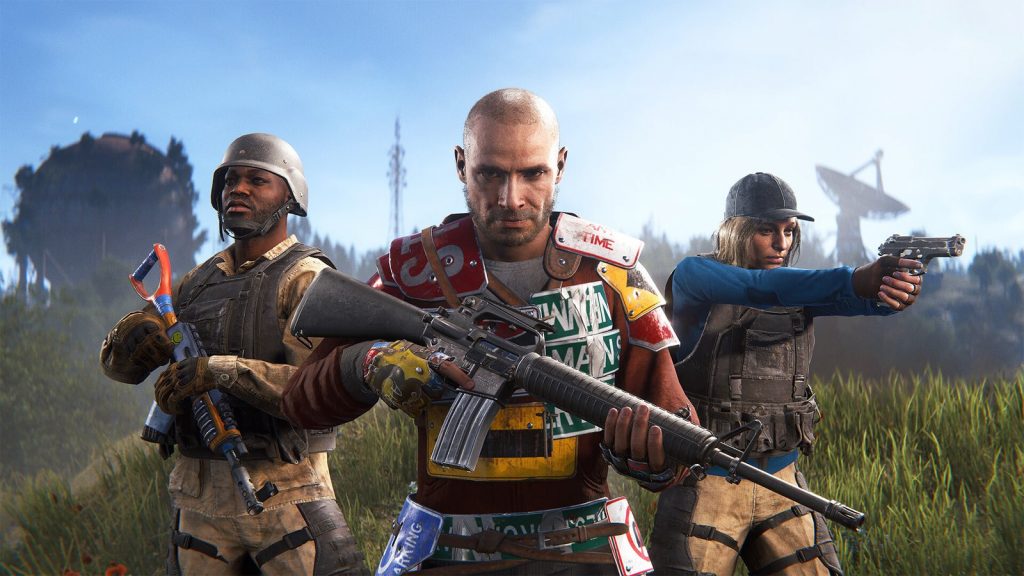
Rust is a PvP game, and the other survivors are its defining feature. Some will be friendly, many will not. Practical advice for your first hours:
- Assume everyone is hostile until proven otherwise. Friendly chat is often followed by a spear to the back.
- Do not carry everything. Bring materials home often. Losing a full inventory hurts far more than losing a rock.
- Avoid roads and monuments early. Monuments hold the best loot, and many have radiation that requires protective clothing, but they attract armed players.
- Use the safe zones. Outpost and Bandit Camp are monuments where fighting is discouraged by guards, letting you trade and recycle components.
- Close your door every time. It sounds obvious; it is the most common way new bases are looted.
Food, water and staying warm
New players often die to the environment rather than to other survivors. Keep an eye on your status bars:
- Food: hunt animals with a spear or bow and cook the meat on a campfire. Mushrooms, pumpkins, corn and other plants found in the wild help too. Cook meat whenever possible rather than eating it raw.
- Water: drink from freshwater rivers and lakes by looking at the water and pressing the interact key. Later you can carry water in a bottle or jug.
- Temperature: nights, snowy areas and swimming all cool you down. Wear clothing, stand near a campfire, or stay indoors. Deserts can overheat you in heavy clothing.
- Wildlife: wolves, bears and big cats are serious threats early on. Do not hunt a bear with a rock.
A campfire inside or beside your base solves cooking and warmth in one go, and a few bandages in your hotbar handle bleeding after an animal attack.
Wipes: why everything resets
Rust servers regularly reset their maps in what players call a wipe. Facepunch performs a forced wipe on the first Thursday of each month, which resets structures and blueprints alike on official servers, and many community servers wipe more often, weekly or every two weeks. Do not get too attached to your first base. Every wipe is a fresh start, which is exactly why joining shortly after one is ideal.
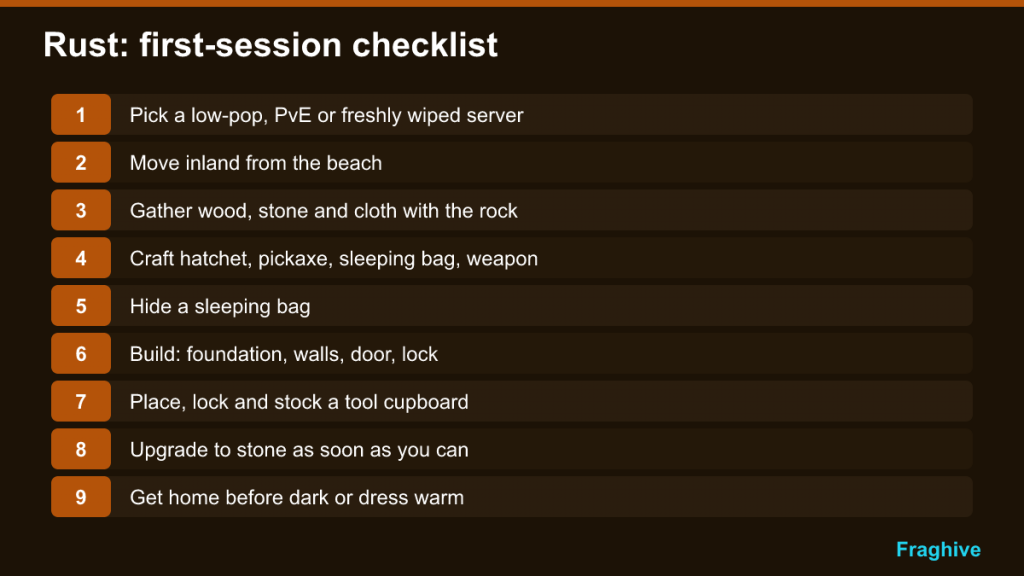
A simple first-session checklist
- Choose a low-population or PvE server that recently wiped, or one with Tutorial Island enabled.
- Move inland from the beach immediately.
- Gather wood, stone and cloth with the rock.
- Craft a stone hatchet, stone pickaxe, sleeping bag and a weapon.
- Hide a sleeping bag.
- Build a small base: foundation, walls, door, lock.
- Place a tool cupboard, lock it and stock it.
- Upgrade to stone as soon as you can.
- Head home before dark, or wear clothing to stay warm.
Is Rust for you?
Rust is a game of high tension and real loss. Some players love that every decision carries weight; others find it exhausting. If you enjoy the gathering and building but not the constant threat, a PvE or modded server lets you experience the systems on your own terms. And if you want something gentler to start your survival journey, our Minecraft first-night guide covers a far more forgiving take on the same gather, craft and shelter loop.