Rust Wipes Explained: Forced Wipes, Map Wipes and Blueprint Wipes
What a Rust wipe actually resets, why the monthly forced wipe lands on the first Thursday, and how weekly or biweekly server wipes shape every game.
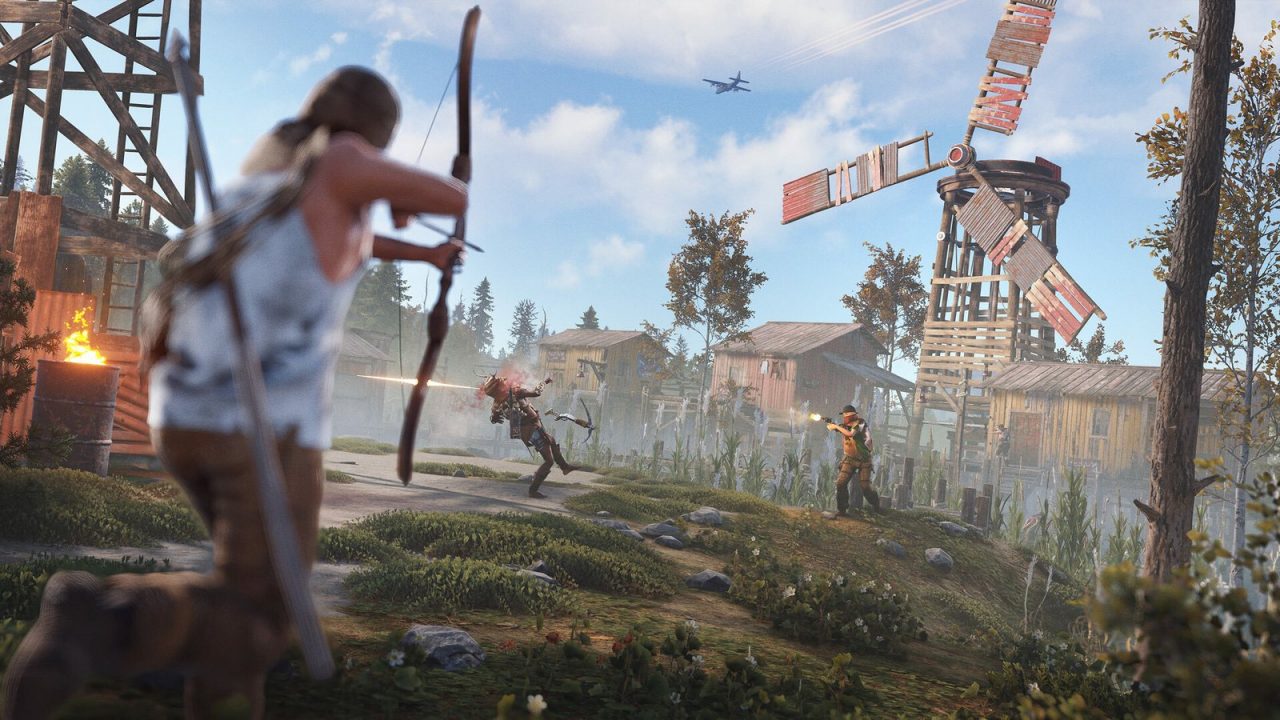
Almost every survival game lets you keep your house forever. Rust does not. Every Rust server is periodically reset to a blank island, and everything players built, stored and fought over disappears. This reset is called a wipe, and it is the single most important thing to understand about how Rust is played. It decides when you should join a server, how fast you need to progress, how big your base should be and even when the most violent days of the month happen.
This guide explains the different kinds of wipe, what each one clears, how the monthly forced wipe works and how individual servers set their own schedules. If you have not played yet, our Rust beginner’s guide covers your first hours on the beach; this piece is about the bigger rhythm that sits around them.
What a Wipe Is and Why Rust Needs It
Rust is a multiplayer survival game in which players gather resources, build bases and raid each other. Without resets, a server would eventually be dominated by a few huge groups sitting on enormous stockpiles in fortress bases, and any new player joining late would have no realistic chance. Wipes solve that. By returning the server to its starting state on a regular schedule, they give everyone a fresh, equal start and keep the core loop of gathering, building and raiding meaningful.
Wipes also solve a technical problem: major updates often make old save data incompatible, so the world has to be regenerated anyway. The result is that a Rust “game” is not a single match or an endless world, but a wipe cycle: a period of days or weeks that starts on wipe day and ends at the next wipe. Players often talk about “this wipe” the way other gamers talk about “this season”.
Map Wipes: The Standard Reset
A map wipe (sometimes just called a wipe) resets the world. In practice that means:
- All player-built structures are deleted: foundations, walls, doors, tool cupboards, furnaces and every deployable.
- Everything stored in those bases is gone, including weapons, armor, resources and scrap.
- Players lose their inventories and respawn as fresh characters with only the basic starting kit, a rock and a torch.
- The map itself returns to its original state. Many servers also change the map seed or size at this point, so the island may be a brand-new layout.
What a map wipe usually does not touch is your blueprint knowledge. Blueprints are the recipes you have unlocked, and on servers that only do map wipes, you keep them from one cycle to the next. That makes later cycles faster for experienced players: they can craft mid-tier gear as soon as they have materials and a workbench, instead of researching everything again.
Blueprint Wipes: Resetting Progression
To understand blueprint wipes you need to know how Rust progression works. According to the official Rust wiki maintained by Facepunch, blueprints unlock the ability to craft specific items. You obtain them either by researching an item at a research table, which costs scrap plus a copy of the item, or by finding blueprints in crates and barrels. Workbenches also offer a tech tree where you spend scrap to unlock specific items, which removes some of the luck from progression.
A blueprint wipe (often shortened to “BP wipe”) clears that knowledge. After a BP wipe everyone starts from zero again, with only the basic recipes known. This is a much bigger reset than a map wipe: early days become slower, scrap becomes far more valuable and the first few hours turn into a race to unlock key items such as better weapons and armor.
How often blueprints are wiped depends on the server. Some community servers wipe blueprints every time they wipe the map, which keeps every cycle equal. Others wipe blueprints only once a month or even less often, rewarding regular players. Facepunch’s forced wipe resets the map on every server; whether a particular forced wipe also clears blueprints on a server has varied over the game’s history and between server types, so the safest approach is to read the server’s description or its listed wipe information before you commit.
Rust’s progression system itself has changed over the years. Wikipedia’s history of the game notes that blueprints were removed in July 2016 and replaced with an experience-and-levels system, which was then swapped for a component-based system in November 2016, before blueprints eventually returned.
The Monthly Forced Wipe
The forced wipe (or “force wipe”) is the one reset nobody can avoid. Facepunch releases a major update for Rust once a month, and that update is incompatible with old map saves, so every server, official or community, must wipe its map when it installs the update.
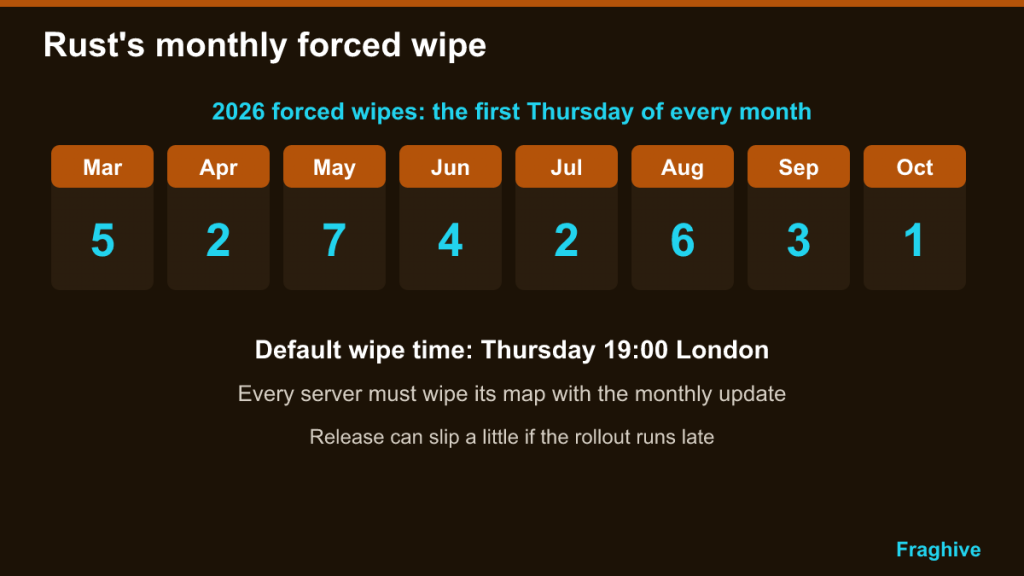
The timing is predictable. Facepunch’s monthly updates arrive on the first Thursday of each month. The official Rust news page shows this pattern clearly through 2026: for example, updates were posted on Thursday 5 March, Thursday 2 April, Thursday 7 May, Thursday 4 June, Thursday 2 July, Thursday 6 August, Thursday 3 September and Thursday 1 October 2026. Each of those is the first Thursday of its month.
The time of day is also standardized. The official wiki page for the in-game Server Wipe Timer explains that its default schedule is Thursday at 19:00 London time, and that the default monthly setting is the first Thursday of the month, “matching force wipes”. That translates to 2 p.m. Eastern or 11 a.m. Pacific in the US when London is on GMT, but daylight saving changes can shift the local equivalent, so it is worth checking the clock in your own time zone. Release day can also slip by a little if Facepunch’s rollout runs late, and servers then need time to download the update and restart.
Wikipedia notes that after Rust left early access, Garry Newman said updates would move from weekly to monthly to avoid breaking the game with rushed releases. That decision is the origin of today’s predictable monthly forced wipe.
Server-Chosen Wipe Schedules
Between forced wipes, each server sets its own rhythm. The common options are:
| Schedule | Typical pattern | Who it suits |
|---|---|---|
| Monthly | Only the forced wipe, on the first Thursday | Players with limited time who want a long cycle and big bases |
| Biweekly | Forced wipe plus one mid-month wipe | Regular players who want a balance of building and fresh starts |
| Weekly | A wipe every week, usually Thursday | Groups that play intensively and enjoy the early-wipe rush |
| Custom | Any day or hour the owner chooses | Community and modded servers with a specific audience |
Facepunch’s official server documentation spells out how these defaults work. A server is tagged as monthly, biweekly or weekly. Monthly means the first Thursday of the month; weekly means every Thursday; biweekly means the first and third Thursday, and in months with five weeks the three-week gap is split into two weeks plus one. Server owners can change the day of the week, the hour, the time zone or even provide a full cron expression for unusual schedules, and an admin command called PrintWipe lists the next scheduled wipe dates.
Many community servers also put the schedule in their names, such as “Weekly” or “BP Monthly”.
The Wipe Timer and Endgame Events
Rust also signals the coming wipe inside the game. According to the official wiki, the lowest level of the Nuclear Missile Silo monument contains a countdown attached to a warhead and a laptop. It counts down to the next server wipe, using the same schedule settings described above.
The same timer controls end-of-wipe events. On the final day before a wipe, the server can trigger special events: F-15E jets flying over the island, which are atmospheric, and “road Bradleys”, armored vehicles that patrol the roads and attack what they see, while scientist numbers increase. Server owners can disable these by setting the relevant hours-before-wipe value to zero. They exist to make the last day of a cycle feel like a finale rather than a quiet fade-out.
How Wipe Timing Shapes the Way People Play
Once you understand the cycle, a lot of Rust behavior makes sense.
Wipe day is the busiest day
Servers are often packed on wipe day. Everyone starts equal, the map is new and the best building spots are open. The first hours are a scramble for resources, a quick starter base and early scrap from barrels and roadside loot. Groups who want to dominate the cycle play hard from the first minute.
Mid-wipe is about stability
After the first couple of days, population usually settles. Established groups farm, upgrade from wood to stone and metal and run monuments for components.
The end of a wipe is for raiding
Since everything will be deleted anyway, the final day or two before a wipe is when many players spend their stockpiles. Explosives that were saved “just in case” get used, large groups raid each other and players take fights they would avoid earlier.
Base design depends on cycle length
On a weekly server, an enormous fortress may not be worth the materials, because it will be deleted in a few days. On a monthly server, a larger, more defensible base pays off. Upkeep matters too: the tool cupboard consumes resources to prevent decay, so a bigger base costs more to maintain for every day of the cycle.
Choosing a Server Around the Wipe Schedule
A few practical rules help new and returning players:
- Join on or just after wipe day. Join late and everyone else already has guns and stone bases.
- Match the schedule to your free time. If you can only play on weekends, a weekly server that wipes on Thursday leaves you joining two days behind. A monthly or biweekly server may suit you better.
- Check blueprint rules. If you are new, a server that wipes blueprints regularly keeps everyone closer to your level. If you are returning, keeping blueprints can save hours.
- Look at population and group limits. A low-population or solo/duo/trio server makes the early-wipe rush less punishing, which pairs well with the advice in our survival crafting genre explainer about choosing PvE-leaning settings.
- Expect forced wipe day to be chaotic. Servers can be slow to come back while they update, and new monthly content draws returning players. Patience in the first hour is normal.
Common Misunderstandings
“A wipe means my account is reset”
No. Wipes are server-side. Your Steam account, purchased skins and items bought in the store are unaffected. What resets is your in-world character, base and, on a BP wipe, your learned blueprints on that server.
“A forced wipe always clears blueprints”
The map is always reset at a forced wipe, but blueprint handling depends on the server and on the specific update. Read the server’s information instead of assuming.
Quick FAQ
When is the next forced wipe? On the first Thursday of the coming month, at 19:00 London time by default. After the 1 October 2026 update, the next one falls on Thursday 5 November 2026 if the usual pattern holds.
Do console servers follow the same rule? Rust’s console edition has its own servers and update schedule, so check its official channels separately; this guide describes the PC game.