Fortnite Building Explained: Walls, Ramps, Edits and Materials
A plain-English guide to Fortnite building: the four build pieces, wood vs stone vs metal, editing, structural collapse, and ramp rushes, 90s and box fights.

Building is the feature that made Fortnite stand out from every other battle royale. In the middle of a firefight, players can conjure walls, ramps and towers out of thin air, turning a simple shootout into a race for cover and height. To a new player it can look like chaos. In reality it rests on a small set of pieces, three materials and a handful of techniques that build on each other. This guide explains each in plain terms, so you can understand what experienced players are doing and start practicing the useful basics yourself.
Where building materials come from
In Build modes, your pickaxe doubles as a harvesting tool. Swinging it at objects in the world gives you materials:
- Wood comes from trees, pallets, wooden furniture and wooden buildings.
- Stone (shown in the game as brick) comes from rocks, brick walls and stone structures.
- Metal comes from cars, machinery, metal containers and industrial buildings.
You also pick up materials from eliminated players and from loot around the map. Harvesting makes noise and leaves you exposed, so most players gather in short bursts while moving and top up from opponents they defeat.
When you hit an object, a small target circle sometimes appears on it. Hitting that weak point speeds up harvesting. It is a minor detail, but over a match it adds up.
The four build pieces
Every structure in Fortnite is made from four basic pieces, each snapping to a grid:
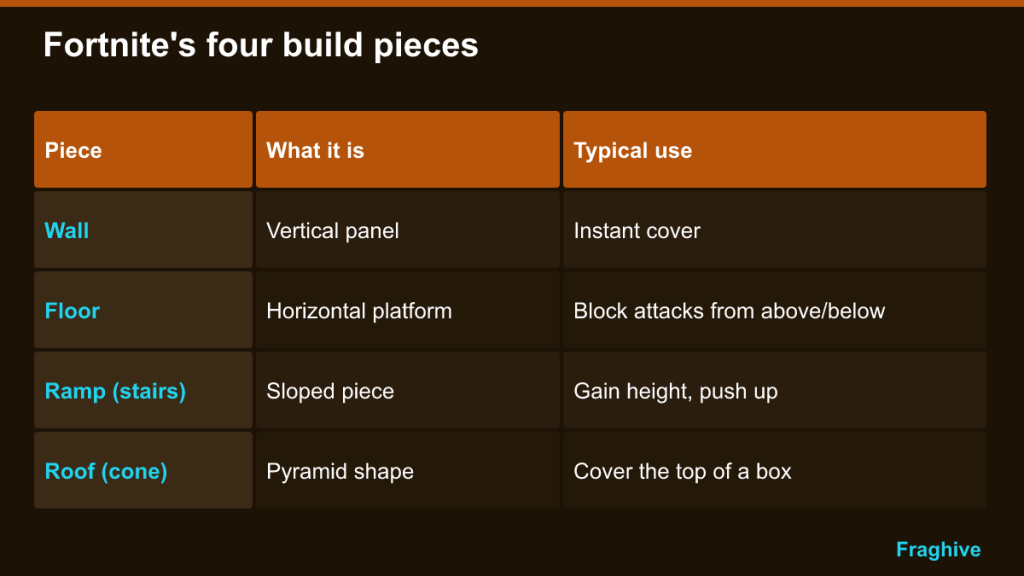
| Piece | What it does | Typical use |
|---|---|---|
| Wall | A vertical panel | Instant cover, protection on all sides of a box |
| Floor | A horizontal platform | Standing surface, blocking attacks from below or above |
| Ramp (stairs) | A sloped piece | Gaining height, moving up toward an opponent |
| Roof (cone) | A pyramid-shaped piece | Covering the top of a box, protecting from above |
Because everything snaps to the same grid, pieces connect in predictable ways. That predictability is what makes fast, complex building possible once you have practiced.
Wood, stone and metal: speed vs strength
All three materials can make every piece. The difference is a trade-off between speed and durability:
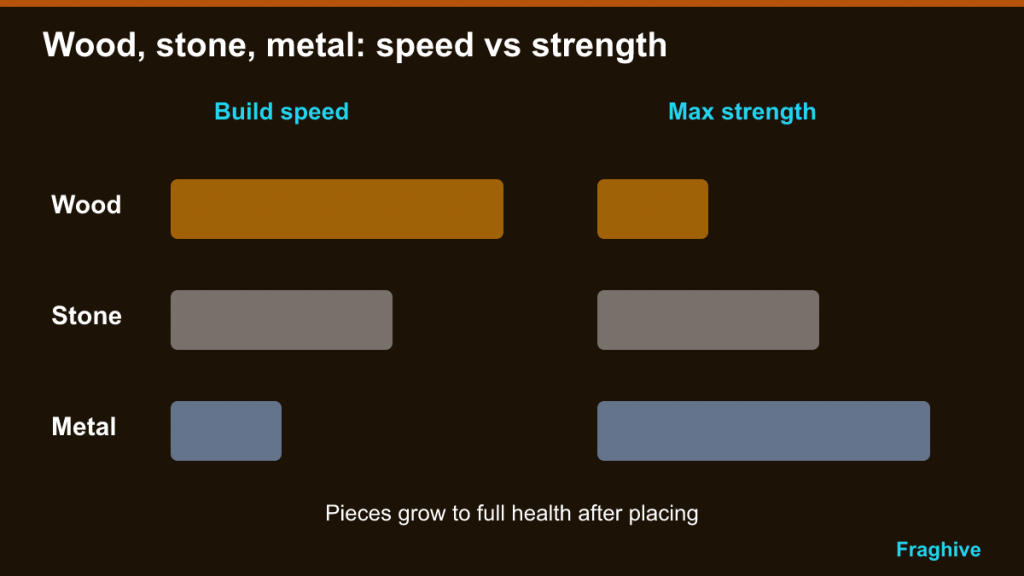
- Wood builds up the fastest but has the lowest maximum health.
- Stone sits in the middle: slower to reach full strength than wood, stronger when it gets there.
- Metal is the toughest at full health but takes the longest to finish building.
An important detail: pieces start with only part of their health when placed and “grow” to full health over a short build time. A freshly placed metal wall is not instantly stronger than wood; it becomes stronger as it finishes. That is why many players use wood in fast fights (it reaches full strength quickly) and switch to stone or metal when they have time to fortify.
Epic has adjusted the exact health values and build times across the game’s history, so we do not quote precise numbers here. The principle of wood for speed and metal for strength has stayed consistent.
Editing: doors, windows and openings
Once a piece is placed, you can edit it. Entering edit mode shows the piece as a grid of tiles; selecting tiles and confirming removes them or changes the shape. Edits let you:
- Cut a doorway or window in a wall
- Turn a floor into a half or quarter platform
- Change a ramp’s direction or shape
- Reshape a roof to create openings
Editing is key to offense. Players inside a box often edit a small window in a wall, take a shot, then reset the edit to close it again. Editing your own pieces is fast and safe. You can only edit pieces you or your teammates built; you cannot edit an opponent’s structures, which is why taking control of space matters so much in close fights.
Many players turn on a setting to confirm edits on release, which shortens the input to a single press and release. Experiment with edit settings in a practice environment until edits feel natural.
Structure damage and collapse
Every piece has health. Weapons, explosives and pickaxes damage it, and a piece at zero health breaks. Fortnite also has a basic support system: structures need to be connected to the ground or to the terrain through other pieces. If you destroy the bottom of a tall tower, the pieces that relied on it for support can collapse, and players standing on top fall.
This creates both a risk and an opportunity:
- If you build high, protect your base pieces. A single opponent shooting out the bottom of your ramp can bring you crashing down.
- If an opponent is high above you on a long ramp, shooting out the supporting pieces can drop them, often with heavy fall damage.
Core techniques in plain terms
The panic wall
The simplest and most useful technique: when you are shot unexpectedly, place a wall between you and the shooter, then add more pieces as needed. Many beginners practice this reflex before anything else, and it saves countless matches.
The box (and box fighting)
A box is four walls around you, plus a floor and a roof or cone if you have time. It gives you safety to heal, reload or think. Box fighting refers to close-range fights in which both players build boxes and try to gain the upper hand by editing windows to shoot, pushing into the other player’s box, or taking over its walls. It rewards fast edits and good shotgun or SMG aim.
The ramp rush
To push an opponent on higher ground, players build a ramp toward them, usually with a wall in front of the ramp for protection, and keep placing wall-ramp pairs while moving forward. This lets you climb toward an enemy while staying covered. The weakness of a ramp rush is that the base can be shot out, so speed and protection matter.
The 90s
“90s” refers to a sequence where a player builds a ramp, turns 90 degrees and builds again, rotating around inside a small tower to climb straight up. Done quickly, it gains height while staying protected on several sides. It is one of the most recognized “high ground” techniques.
Taking high ground
All of these techniques serve a simple goal: height. A player above can see and shoot down at an opponent, while the player below must expose more of themselves to shoot up. Much of competitive build fighting is a battle for the top of the structure.
Controls, turbo building and practice
Fortnite offers several control layouts, including a “Builder Pro” layout on controllers that maps each piece to its own button. Most players also use a setting that lets you hold the build button to place pieces continuously as you move your aim, often called turbo building. These options lower the barrier to building quickly.
Practice works best in short, focused sessions:
- Place each of the four pieces until switching between them is automatic.
- Build a box in place repeatedly, then practice editing a window in each wall.
- Practice ramp rushes over flat ground, adding a wall in front each time.
- Try a simple set of 90s to gain height.
- Practice panic walls by having a friend shoot at you, or by turning around quickly at random.
Fortnite Creative, which Epic added in December 2018, is home to many practice islands built for exactly this purpose.
Common building mistakes
- Over-building. Using all your materials early leaves you empty in the final circles, where building matters most.
- Building tall in the open. A huge tower attracts every player in sight and is vulnerable to having its base shot out.
- Forgetting to shoot. Building is a tool. Fights are won by damage, not by the size of your structure.
- Always using wood. Wood is fast but weak. When you have time, reinforce with stone or metal.
- Not watching material counts. Glance at your totals after each fight and harvest when you are low.
Zero Build: playing without it
Not everyone wants to build. In March 2022 Epic introduced Zero Build, a version of Battle Royale with building removed, and made it a permanent option in April 2022. Without building, players get a regenerating overshield on top of normal health and shields, and cover, terrain and mobility items take on the role that structures play in Build modes. Many newcomers start in Zero Build and switch to Build later. If you are just getting started with Fortnite as a whole, our Fortnite beginner’s guide explains how a match flows in both modes.
Why building matters to the battle royale formula
In most battle royales, cover is fixed: you work with the walls, rocks and buildings the designers placed. Fortnite lets every player carry their own cover. That changes the rhythm of fights, rewards mechanical skill, and gives players a way out of bad positions that other games simply do not offer. It is a big reason Fortnite’s competitive scene and its casual audience can feel like two different games, and why Zero Build was such a popular addition. For a broader view of how Fortnite fits into the genre, see our battle royale explainer.