Fortnite for Beginners: How a Battle Royale Match Works
New to Fortnite? Follow a match from the Battle Bus to the final storm circle, with loot rarity, materials, healing and Build vs Zero Build explained.
Fortnite Battle Royale has been free to play since it launched in September 2017, and it now runs on just about every modern platform, from PC and consoles to phones and the Nintendo Switch 2. That accessibility means a lot of new players jump in without knowing what is happening. This guide walks through a standard match from start to finish, explains the systems you will see every game, and suggests simple priorities for your first matches. We have kept it independent of any single season: weapons and map locations change regularly, but the structure of a match has stayed remarkably consistent.
Before the match: picking a mode
When you open the Battle Royale section, you will see a few core choices. The two that matter most for a beginner are:
- Battle Royale (Build): the original version, where you harvest materials and build structures during fights.
- Zero Build: introduced by Epic in March 2022 and made a permanent option in April 2022. Building is removed, and you get a regenerating overshield on top of your normal health and shield.
You also choose a team size: solo, duos, trios or squads of four. A standard match holds up to 100 players. Other options come and go, such as Ranked (added in May 2023), Fortnite Reload (June 2024) and the 32-player Blitz Royale (June 2025), but the standard modes are where to learn the fundamentals.
Our advice: if you have never played a shooter before, start in Zero Build. It lets you focus on movement, aiming and positioning before adding the extra layer of building. If you want to learn building eventually, you can switch at any time.
The Battle Bus and the drop
Every match begins on the Battle Bus, a flying bus that crosses the island along a route that changes each game. A line on your map shows the path. You choose when to jump, then skydive and deploy a glider to land.

Where you land shapes your entire match. Named locations directly under the bus path tend to be crowded; places far from the path are quieter. For your first games, pick a spot a little away from the route, ideally with a few buildings to search. You will find enough gear to fight without being swarmed in the first thirty seconds.
A handy habit: look at the map while you are on the bus, see where other players are likely to go, and mark your intended landing spot so teammates know where you are heading.
Looting: rarity colors and what to grab
Once you land, your goal is to collect a usable kit quickly. Weapons and items are found on the floor, in chests (listen for a distinctive shimmering sound), and from eliminated opponents. Your inventory is limited to five item slots, so you cannot carry everything.
Reading rarity
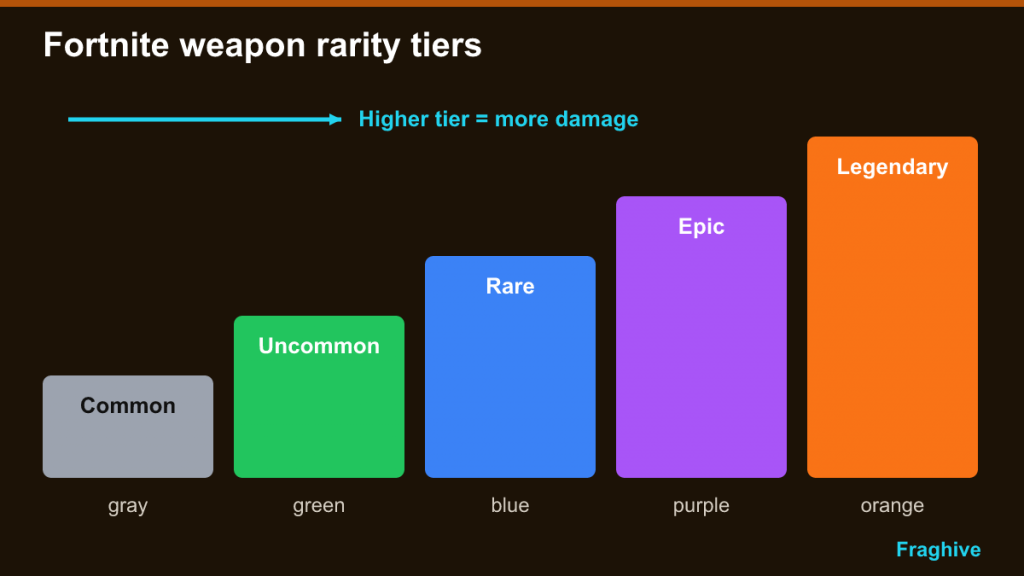
Weapons come in rarity tiers that increase their damage. From lowest to highest the standard tiers are Common (gray), Uncommon (green), Rare (blue), Epic (purple) and Legendary (orange). Above these sit special Mythic and Exotic items, usually tied to bosses, events or vendors. Rarity is a quick guide, not an absolute rule: a weapon type you aim well with often beats a higher-rarity weapon you are uncomfortable using.
A sensible starter loadout
Because the loot pool rotates, specific weapon names change. A balanced kit for five slots usually looks like this:
- One close-range weapon (typically a shotgun or SMG)
- One mid-range weapon (an assault rifle or similar)
- Two slots for healing and shield items
- One flexible slot for a mobility item, utility item or a long-range option
Do not spend minutes perfecting this. Grab something for close range and something for mid range, then move on.
Health, shields and healing items
Your status has two layers: health and shield. Damage hits your shield first, then your health. Healing items fall into a few broad groups:
- Health items restore health but not shield (bandages and medkits are the classic examples).
- Shield items add shield (small shield potions top you up quickly, larger ones add more but take longer to drink).
- Combination or over-time items appear in some seasons and restore both, sometimes gradually.
Almost all of them take a moment to use, and you are vulnerable while consuming them. Always break line of sight first: duck behind a wall, go inside a building, or (in Build mode) put up a quick box around yourself.
In Zero Build, the extra overshield regenerates on its own after you avoid damage for a short time. That makes disengaging from a losing fight more valuable: step back, let it recharge, and re-engage.
Materials and building basics
In Build modes your pickaxe is also a resource tool. Hitting trees, walls, cars and rocks collects three materials: wood, stone and metal. Each can be turned into four basic pieces: walls, floors, ramps and roofs (often called cones).
The materials trade speed for strength. Wood goes up fastest but is the weakest; metal is the strongest but takes longest to reach full health; stone sits in the middle. For a beginner, wood is the most forgiving because pieces appear quickly.
You do not need advanced techniques to benefit from building. Three simple uses go a long way:
- Instant cover: if you are shot in the open, place a wall between you and the shooter.
- A box to heal in: four walls (and a floor or roof if you have time) give you a safe space to heal.
- A ramp for height: high ground gives you better angles and makes you harder to hit.
Spend a few minutes in Creative or a quiet corner of the map just placing pieces. Comfort with the controls matters more than speed at first.
The storm: Fortnite’s shrinking circle
The storm is Fortnite’s version of the battle royale safe zone. The playable area is shown on your map as a circle; outside it, the storm deals damage over time, and that damage increases in later phases. Each phase follows a rhythm: a countdown while the next safe circle is shown, then a period where the storm closes in.
Some practical rules:
- Check the map every time a new circle appears. Decide early how you will get there.
- Moving early is usually safer than moving late. Running in front of the storm means everyone already inside can see you coming.
- Carry or look for mobility (vehicles and mobility items vary by season) when you are far from the next zone.
- In early phases the storm is mild enough to cross briefly if needed. In late phases it is not.
Fighting: when to take a fight and when to avoid it
Every shot you fire reveals your position. A good habit is to ask three questions before engaging:
- Do I have the advantage (better position, they have not seen me, they are already damaged)?
- Can I finish the fight quickly?
- Where will I heal afterward, and who might hear it?
If the answers are “no,” it is often better to let a team pass. Late in a match, being patient wins more games than chasing eliminations. When you do eliminate someone, loot quickly and only take what improves your kit.
Team modes: reviving and rebooting
In duos, trios and squads, a player whose health reaches zero is knocked down rather than eliminated. A teammate can revive them by holding the interact button nearby. If a player is fully eliminated, teammates can pick up their reboot card and bring it to a Reboot Van to bring them back, as long as the van is available. Rebooted players return with very little gear, so share spare weapons and healing.
Communication helps even without voice chat. Use the ping or marker button to highlight enemies, items and destinations.
First-match priorities checklist
- Pick Zero Build if you are new to shooters; switch to Build when you are comfortable.
- Land slightly away from the bus path, near a cluster of buildings.
- Get a close-range weapon, a mid-range weapon and at least two healing or shield items.
- Check the map at each new storm circle and move early.
- Heal behind cover, never in the open.
- In Build mode, practice the “wall when shot” reflex.
- Do not chase every fight; third parties are common.
Common beginner questions
Do I have to pay to play?
No. Fortnite Battle Royale is free to play and makes money through optional purchases with V-Bucks, its in-game currency. Cosmetics do not change your character’s abilities.
Why do I keep losing to builders?
Experienced builders can create cover and height faster than you can aim. That is exactly why Zero Build exists. If you prefer building, keep practicing the basics described above, and see our explanation of how battle royale games work for the broader context of why positioning matters so much.
Is Creative the same thing as Battle Royale?
No. Fortnite Creative, added in December 2018, is a separate mode where players build their own islands and games. Many players use Creative islands to practice aiming and building without the pressure of a real match, which makes it a useful training ground once you know the basics described here.
Does the map stay the same?
No. Fortnite’s island changes between chapters and seasons, and special modes sometimes bring back older versions. Rather than memorizing one map, learn to read any map: where the cover is, where the high ground is, and how you will reach the next circle.